

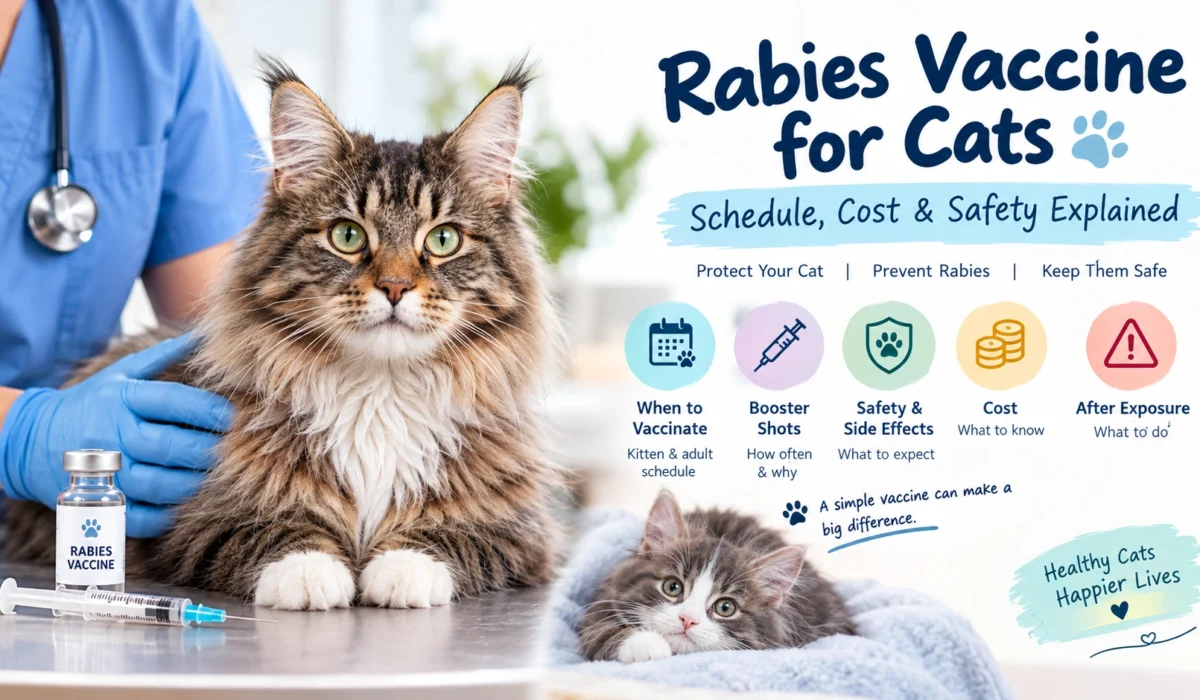
Rabies Vaccine for Cats: Schedule, Cost & Safety Explained
Rabies is one of those diseases most cat owners hope they never have to think about. But a simple rabies vaccine for cats is one of the most important preventive steps you can take.
Even an indoor cat can potentially encounter a bat or other wildlife that enters the home. Outdoor cats have more opportunities to come into contact with wildlife. In the United States, more than 90% of reported animal rabies cases occur in wildlife. Bats, raccoons, skunks, and foxes are among the main wildlife reservoirs.
Cats are also the most frequently reported rabid domestic animal in the U.S., with roughly 200 to 300 reported cases each year.
The good news is that rabies is preventable through vaccination.
This guide explains when cats need a rabies shot for cats, what the kitten schedule usually looks like, what the vaccine protects against, possible side effects, and what to do after a possible rabies exposure.
What Is the Rabies Vaccine for Cats?
The rabies vaccine helps prepare a cat’s immune system to fight rabies virus if the animal is exposed later.
Rabies is a viral disease that attacks the nervous system. Once clinical signs develop, the disease is almost always fatal. There is no effective treatment that cures rabies in an infected animal. Prevention is therefore the central strategy.
A rabies vaccine for cats is considered a core vaccine where rabies is endemic or when vaccination is required by law. The FelineVMA/AAFP vaccination guidance also emphasizes that vaccine decisions should take the cat’s age, lifestyle, environment, and exposure risk into account.
Rabies vaccines for cats must be administered by a veterinarian or under veterinary supervision and in accordance with applicable laws.
When Should a Kitten Get a Rabies Vaccine?
One of the most common questions from new owners is: When should my kitten get a rabies vaccine?
In the U.S., many cats receive their first rabies vaccine at about 12 weeks of age or older, depending on the vaccine product and state requirements. CDC notes that most cats should not be vaccinated before 12 weeks because the immune response is not as strong in very young animals.
Cornell notes that rabies vaccination timing can vary with the vaccine type and that cats may receive the vaccine around 8 to 12 weeks in some protocols. This is why your veterinarian should determine the exact timing rather than relying on a generic online schedule.
For many kittens, rabies vaccination is part of a broader preventive-care plan that may also include other kitten vaccines such as FVRCP.
The schedule matters because kittens receive protective antibodies from their mothers. Those antibodies gradually decline and can interfere with vaccination at a very young age. Veterinary guidelines therefore use age-appropriate vaccination windows to establish protection.
Typical kitten rabies timeline
A common U.S. approach looks like this:
Around 12 weeks or older: First rabies vaccine when permitted by the vaccine label and local law.
About 1 year later: First booster.
After that: Boosters according to the vaccine’s labeled duration of immunity and state or local requirements. Some licensed products provide one-year protection while others are labeled for three years.
Your veterinarian may recommend a different schedule based on your cat’s medical history, vaccine product, age, and location.
Why Does a Kitten Rabies Vaccine Matter?
It can be easy to think rabies is only a concern for outdoor animals. That is a mistake. Bats can enter homes through surprisingly small openings. A cat that encounters a bat may be exposed before an owner realizes what happened.
A vaccinated cat is better protected than an unvaccinated cat and is also easier to manage from a public-health standpoint after an exposure.
There is a human health benefit too. CDC reports that around 100,000 people receive rabies post-exposure prophylaxis each year after potential exposure.
Keeping pets vaccinated helps reduce the likelihood that a human family member will face a preventable rabies exposure.
Do Indoor Cats Need a Rabies Shot?
Yes, an indoor cat may still need rabies vaccination. Whether vaccination is legally required depends on the state or local jurisdiction. CDC specifically advises owners to vaccinate cats according to local laws.
There is also a practical reason to vaccinate indoor cats.
- A bat can get inside your house.
- A cat can escape through an open door.
- A wildlife exposure can happen unexpectedly.
Cornell explains that many states require rabies vaccination for cats and that the disease is serious because infected animals can transmit rabies through bites or scratches involving saliva.
So even when your cat spends every night indoors, discuss rabies vaccination with your veterinarian.
What Does a Rabies Shot for Cats Protect Against?
A rabies shot for cats protects against infection with rabies virus. Rabies is usually spread when saliva from an infected animal enters the body through a bite wound or another route that allows the virus to reach susceptible tissue. All mammals can be infected.
Common rabies reservoirs in the United States include:
- Bats
- Raccoons
- Skunks
- Foxes
Vaccination is not a substitute for avoiding wildlife. It is another layer of protection.
Rabies Vaccine for Cats: What Happens at the Appointment?
A typical vaccination appointment starts with a physical examination. Your veterinarian may ask about:
- Your cat’s age
- Previous vaccines
- Indoor or outdoor lifestyle
- Travel
- Wildlife exposure
- Current medications
- Previous vaccine reactions
- General health
The vet will then administer the vaccine according to the product’s instructions and local requirements.
A rabies vaccination certificate is normally provided. Keep this document somewhere safe because proof of vaccination may be needed for boarding, travel, licensing, veterinary records, or after an exposure.
Animal rabies vaccines should only be administered by a veterinarian or under direct veterinary supervision.
Are Rabies Vaccines Safe for Cats?
Rabies vaccines are widely used and are considered an important part of preventive feline healthcare.
As with any medical treatment, side effects can occur. Mild reactions may include temporary soreness or tiredness after vaccination. More serious reactions are uncommon but can occur and require veterinary attention.
Cornell notes that short-term vaccine risks are primarily allergic reactions. It also discusses the long-term concern of feline injection-site sarcomas, which are uncommon tumors associated with injection sites and have been an area of ongoing veterinary research.
This does not mean owners should avoid vaccination. Instead, discuss your cat’s individual risks with your veterinarian. A vet can consider previous reactions, the benefits of vaccination, the cat’s lifestyle, and the specific vaccine being used.
When should you call the vet after vaccination?
Contact your veterinary clinic if your cat develops unusual or concerning symptoms after vaccination, especially facial swelling, breathing difficulty, collapse, severe weakness, or another sign that looks like a medical emergency.
Your veterinarian can tell you whether the reaction requires immediate treatment.
Is There a Difference Between Kitten Vaccines and the Rabies Vaccine?
Yes.
Rabies vaccination is separate from the standard combination vaccines used to protect kittens against several common feline diseases.
One of the main kitten vaccines is FVRCP. Cornell explains that this combination protects against feline panleukopenia, feline herpesvirus-associated disease, and calicivirus.
The FelineVMA/AAFP guidelines stress that vaccination plans should be individualized according to age, environment, and lifestyle.
That means a kitten may receive several different vaccinations during its early months rather than one single injection that protects against everything.
A Real-World Example: An Indoor Maine Coon
Consider a family bringing home a Maine Coon kitten.
The family plans to keep the kitten indoors. They assume rabies is therefore unnecessary. A few months later, a bat gets into the house. The kitten chases it across the living room.
The family cannot determine whether the kitten was bitten. This is exactly the type of situation that makes preventive vaccination valuable.
The vaccine does not mean you should allow your cat to interact with wildlife. It simply adds protection when an unexpected event occurs.
At Bella Dolce Maine Coon, responsible kitten care starts with preparing owners for the long-term needs of their cats. Veterinary care and appropriate vaccination are important parts of that responsibility.
New owners can also review our Maine Coon kitten care guide for information on nutrition, grooming, socialization, daily routines, and helping a kitten settle into a new home.
What If a Vaccinated Cat Is Exposed to Rabies?
If your vaccinated cat is bitten or scratched by a potentially rabid animal, contact your veterinarian and local public health authorities promptly. Do not assume that vaccination means the exposure can be ignored.
CDC states that cats and other vaccinated animals exposed to rabies should receive an immediate booster and be monitored for signs of rabies for 45 days under the applicable public-health guidance.
The exact response depends on the animal involved, the type of exposure, vaccination history, local law, and public-health assessment.
What if the cat has never been vaccinated?
An unvaccinated cat that is exposed can face much more serious consequences. CDC notes that unvaccinated dogs, cats, and ferrets exposed to rabies generally require euthanasia or strict quarantine under current public-health recommendations if the owner declines euthanasia. Immediate vaccination is also part of the management approach.
That is one reason keeping rabies vaccination current is so important.
What Should You Do After a Possible Rabies Exposure?
If your cat has been bitten or scratched by wildlife or another animal that may have rabies:
- Separate your cat from other pets and people if necessary.
Avoid unnecessary contact with saliva or wounds.
- Contact a veterinarian immediately.
Do not wait for symptoms to appear.
- Contact local animal control or public health authorities when advised.
Rabies exposure is a public-health matter as well as a veterinary issue.
- Do not handle a bat or wild animal with your bare hands.
Even a small bat bite can be difficult to notice.
- If a person was bitten or scratched, seek medical advice immediately.
CDC emphasizes that people with possible rabies exposure need urgent medical assessment.
Do not attempt to diagnose rabies at home.
Signs of Rabies in Cats
You should never wait for symptoms before taking a suspected exposure seriously.
Possible clinical signs can include:
- Sudden behavior changes
- Aggression
- Unusual friendliness or altered behavior
- Weakness
- Loss of coordination
- Difficulty swallowing
- Excessive salivation
- Paralysis
- Seizures
Importantly, these signs are not unique to rabies. Many other medical problems can produce similar symptoms. Only veterinary and public-health professionals can properly evaluate a suspected exposure.
How Much Does a Rabies Vaccine for Cats Cost?
The cost of a rabies vaccine for cats varies across the United States.
Your total bill can depend on:
- The veterinary clinic
- Your location
- Whether an exam is required
- The vaccine used
- Whether other vaccines are given at the same visit
- Local licensing requirements
Low-cost vaccination clinics may offer lower prices than a full-service veterinary appointment. Some clinics bundle the examination and vaccine into one visit.
Because prices change by region and provider, it is better to call your local clinic for a current quote rather than relying on a national average.
How Often Does a Cat Need a Rabies Shot?
The answer depends on the vaccine product and local requirements. Many cats receive their first booster one year after the initial vaccination. After that, the booster interval may be one or three years depending on the vaccine’s label and the laws where you live.
The important point is to follow your veterinarian’s schedule and keep documentation up to date.
If your cat is overdue, contact your veterinarian rather than assuming the entire vaccine series must automatically start over.
CDC notes that management of overdue vaccinated animals after exposure is handled based on vaccination history and public-health assessment.
Final Thoughts
The rabies vaccine for cats is one of the simplest ways to protect both your cat and the people around you from a devastating disease.
For kittens, the first kitten rabies vaccine is commonly given around 12 weeks of age or later depending on the vaccine and local requirements. A booster is generally given one year later. Future boosters depend on the vaccine used and state or local law.
Indoor cats should not automatically be considered risk-free. Outdoor exposure, escaping, and bats entering homes can all create unexpected situations.
For Bella Dolce Maine Coon families, vaccination should be part of a broader preventive-care routine that includes appropriate nutrition, grooming, veterinary examinations, parasite prevention, enrichment, and a safe home environment.
Keep your cat’s vaccination records current and ask your veterinarian about the schedule that fits your cat’s age, lifestyle, and location. That small step can provide important protection when an unexpected encounter happens.
FAQ
At what age should a kitten get a rabies vaccine?
Many cats receive their first rabies vaccine at about 12 weeks of age or older. The exact age depends on the vaccine label and local law. Your veterinarian should determine the appropriate timing for your kitten.
Does an indoor cat really need a rabies vaccine?
An indoor cat may still need rabies vaccination because wildlife such as bats can enter homes. In addition, many states or local jurisdictions require rabies vaccination for cats. Talk with your veterinarian about your local rules and your cat’s risk.
How often does a cat need a rabies shot?
A first booster is commonly given one year after the initial vaccination. Later boosters depend on the specific vaccine and local requirements. Some products are labeled for one year and others for three years.
Can a vaccinated cat still get rabies?
Vaccination provides important protection but does not mean an owner should ignore a possible exposure. A vaccinated cat that is bitten or scratched by a potentially rabid animal still needs prompt veterinary and public-health assessment. CDC recommends an immediate booster for appropriately vaccinated exposed animals.
Also Read: Heated Cat House