

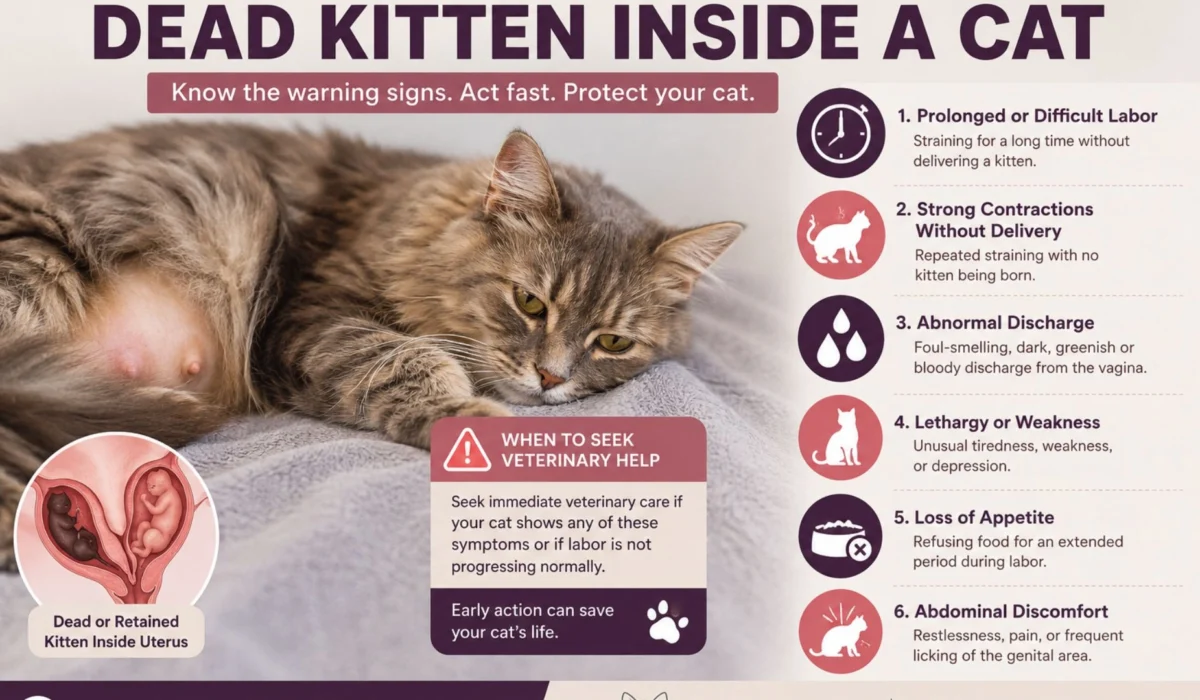
Symptoms of Dead Kitten Inside a Cat : Warning Signs
If you’re worried there’s a dead kitten inside your cat, the short version is: don’t sit on it and wait to see what happens. A kitten that’s died before delivery sometimes passes on its own, but a fetus that stays retained can lead to a difficult labor, infection, or a genuinely sick mother cat. The only reliable way to know what’s actually going on is a veterinary exam.
Knowing the warning signs matters it’s how you catch a potential emergency early. But it’s worth being upfront about a limitation here: symptoms by themselves can’t confirm a kitten has died or is still stuck inside. That answer usually requires an ultrasound, X-ray, physical exam, or some combination of testing from a vet.
Below, we’ll walk through what the symptoms of a dead kitten inside a cat can look like, what retained or stillborn kittens tend to present as during labor, when this becomes an emergency, and what to actually do in the moment.
If your cat is in labor right now and you think a kitten is stuck or has died inside her, call a veterinarian or emergency vet hospital immediately. Don’t try to remove a kitten yourself, and don’t give oxytocin or any other medication without a vet telling you to.
What Does “A Dead Kitten Inside a Canbsp t” Actually Mean?
A kitten can die before birth for a number of reasons. Sometimes that stillborn kitten still gets delivered normally along with the rest of the litter. Other times, a dead fetus contributes to a difficult labor which vets call dystocia or it simply stays inside the uterus and needs veterinary intervention to resolve.
Here’s the thing owners often don’t realize: you can’t reliably tell whether a fetus has died just by feeling the mother’s belly or watching how she’s acting. A vet, on the other hand, can actually assess the pregnancy directly, ultrasound shows fetal viability, and X-rays can reveal how many fetuses are present and roughly where they’re sitting.
That distinction is more important than it sounds, because some things that look alarming during labor are, in fact, completely normal.
What are the symptoms of a dead kitten inside a cat?
What this looks like depends on a few variables: whether the fetus is still in the uterus, whether labor has actually started, and whether complications like infection or dystocia have set in. Here’s what to watch for.
1. Labor Stalls Without the Rest of the Litter Arriving
Prolonged or abnormal labor is one of the biggest red flags. Cats don’t deliver kittens on a fixed schedule; the gap between births can vary quite a bit. Sometimes a mother will pause to rest and nurse the kittens she’s already delivered before straining again; this is often called interrupted labor, and on its own it’s not necessarily a problem.
What is concerning is a long pause combined with visible distress, ongoing contractions that aren’t producing anything, illness, or other signs that something’s off. The Merck Veterinary Manual points to prolonged labor and noticeable maternal or fetal distress as signs that dystocia may be developing.
2. Hard Contractions With Nothing Being Delivered
If your cat keeps straining intensely but isn’t producing a kitten, that’s a difficult birth in progress.
VCA’s general guidance is to seek immediate veterinary attention if a cat has been in intense labor for around 20 minutes without delivering, or if you can actually see a kitten and it hasn’t been expelled after roughly 10 minutes of hard straining.
Don’t talk yourself into waiting it out on the assumption the next kitten will eventually show up on its own.
3. Discharge That Doesn’t Look Right
Some discharge during and after birth is completely normal. Certain kinds, though, are a warning sign:
- Fresh bleeding that keeps going
- A foul smell
- Discharge that’s unusually dark or greenish before a kitten has even been delivered
- Any discharge paired with lethargy or fever
Discharge like this can point to dystocia or another reproductive complication, and it’s worth getting checked out.
4. Sudden Weakness or Lethargy
If the mother becomes noticeably weak, depressed, or lethargic during or after labor, that needs prompt attention.
To be clear, a mom is supposed to be tired after giving birth. What you’re watching for is a real deterioration in her condition, especially when it’s showing up alongside prolonged labor, unusual discharge, fever, vomiting, or a refusal to eat.
5. Not Eating
Cats naturally go off their food as labor approaches VCA notes many queens stop eating in roughly the last 24 hours before delivery. So appetite loss by itself doesn’t mean a kitten has died.
It’s more of a concern if she’s still not eating after delivery, or if it’s showing up together with weakness, fever, vomiting, abdominal discomfort, or other signs something’s wrong.
6. Abdominal Discomfort
A cat dealing with a reproductive complication might seem restless or uneasy, and may repeatedly lick at her genital area.
Abdominal pain has a lot of possible causes though, so this alone isn’t proof of a dead kitten. A vet can actually check whether the uterus is enlarged or whether a fetus is still inside.
Can You Actually Tell If a Kitten Has Died Inside a Pregnant Cat?
No, not from symptoms alone. This is probably the single most important thing to understand as an owner.
A mother cat can go quiet for a stretch during labor and still go on to deliver perfectly healthy kittens. On the flip side, a cat can seem relatively fine while something underneath actually needs treatment. Symptoms just aren’t a reliable stand-in for an exam.
Vets use ultrasound to check fetal viability, and X-rays to figure out how many kittens are present and where they’re positioned, along with other useful details about the pregnancy.
Why Pressing on the Belly Doesn’t Tell You Much
It’s tempting to try counting kittens or feeling for movement by pressing on the abdomen. It’s not a reliable way to figure anything out, and it can just stress or hurt the mother unnecessarily.
If you’re worried a kitten is still inside, a professional exam is genuinely the safer route.
How Long Can a Kitten Be Stuck Before It’s an Emergency?
There’s no universal safe window that applies to every cat. It depends on what stage of labor she’s in, how strong the contractions are, the kitten’s position, the mother’s overall condition, and whether there’s fetal distress.
Merck lists several situations that point to dystocia: strong contractions going on for a while without delivery, long pauses during active labor, abnormal discharge, and clear signs of pain or illness. VCA’s advice lines up with this: get help right away if intense labor continues without a kitten showing up.
The practical rule of thumb: if she’s actively straining and nothing’s coming within the expected window, call your vet. Don’t wait to see if it resolves itself.
What Causes a Kitten to Die Before Birth?
There isn’t always one clear cause. Some possibilities include:
- Developmental problems
- The fetus being in an abnormal position
- Issues with the uterus
- A genuinely difficult labor
- A size mismatch between the fetus and the birth canal
- Pregnancy complications more broadly
- Infection or illness in the mother
Merck notes that fetal-side causes of dystocia can include abnormal positioning and developmental abnormalities, while maternal-side causes often involve the uterus or birth canal.
Sometimes, even after a full veterinary workup, the exact cause of a loss isn’t clear. That’s worth keeping in mind before jumping to conclusions about a specific feeding habit, behavior, or one-off event being “the” cause without actual veterinary evidence behind it.
What To Do If You Suspect a Dead Kitten?
If your cat is pregnant or in labor and something feels off, call your vet right away.
Do:
- Keep her calm and comfortable
- Track the timing and strength of her contractions
- Note the time each kitten is born
- Watch for anything unusual in her discharge
- Keep kittens that have already arrived warm
- Call your vet for guidance
- Get the mother and kittens to the clinic safely if an exam is needed
Don’t:
- Pull on a stuck kitten yourself
- Put fingers or objects into the birth canal
- Give oxytocin without a vet telling you to
- Give calcium or any other medication on your own
- Wait until symptoms get severe before reaching out
Merck specifically flags that oxytocin shouldn’t be used if there’s an obstruction; the right treatment really depends on what’s actually causing the difficult birth and how the mother and kittens are doing.
When Does Labor Become an Emergency?
Get urgent veterinary care if you see:
- Strong contractions with no kitten being delivered
- A kitten visibly stuck in the birth canal
- Significant or ongoing fresh bleeding
- Severe weakness or collapse
- Fever
- Obvious severe pain
- Foul-smelling discharge
- Labor that’s dragging on or looks abnormal
- The mother suddenly becoming very sick
- Any concern that a fetus is still undelivered
Dystocia counts as a genuine veterinary emergency, since both the mother and any unborn kittens can be at risk.
What Happens Once You Get to the Vet
The vet will start by assessing the mother and figuring out how the pregnancy or labor is actually progressing. Depending on what’s going on, that might involve:
- A physical exam
- Checking the abdomen
- Ultrasound
- X-rays
- Bloodwork
- Checking fetal heart rate
Ultrasound helps determine whether the fetuses are alive or in distress, while X-rays can show how many kittens there are, their size, and their position.
From there, treatment depends entirely on the underlying issue. Some situations can be managed medically if there’s no physical obstruction and everyone’s stable. Others need a C-section to safely deliver the kittens.
What If a Kitten Seems to Be Retained After Delivery?
Sometimes an owner gets concerned because the number of kittens born doesn’t seem to match what they expected.
Counting placentas isn’t a reliable way to check, by the way — mother cats often eat them. This is exactly why a veterinary exam beats trying to work it out at home.
If a fetus or fetal tissue is still inside, the mother may show:
- Continued straining
- Abnormal discharge
- Fever
- Reduced appetite
- Lethargy
- Abdominal discomfort
Keep in mind these same signs can also show up with a uterine infection or retained fetal membranes — so they’re not exclusively tied to a retained kitten.
Preparing for a Pregnant Maine Coon Cat
If you’re getting ready for a litter of Maine Coon kittens, solid preparation makes it much easier to spot when something needs attention.
Before labor:
- Set up a quiet space for the birth
- Keep the area clean
- Have fresh bedding ready
- Keep your vet’s number somewhere accessible
- Know where your nearest emergency vet hospital is
- Talk through pregnancy monitoring with your vet ahead of time
- Follow your vet’s nutrition and preventive-care recommendations
After delivery, your vet may want to check both mom and the litter. VCA recommends an exam within 24 hours of delivery to look at the mother, the kittens, milk production, and confirm that everything has actually been delivered.
For a breeder like Bella Dolce Maine Coons, careful preparation, proper veterinary oversight, and responsible care through the litter are all part of doing this right. If you’re looking at bringing home a Maine Coon kitten, it’s worth asking the breeder directly what health monitoring and veterinary care the kittens received before going to new homes.
Final Thoughts
Knowing the symptoms of a dead kitten inside a cat helps you spot when something might be wrong but there’s a real limit here: you can’t reliably diagnose a dead or retained kitten from home.
A quiet stretch during labor doesn’t automatically mean a kitten has died. At the same time, prolonged straining, unusual discharge, fever, serious weakness, a visible obstruction, or other signs of distress are never something to shrug off.
If your cat’s labor doesn’t look right, contact a vet or emergency hospital now, not later. Getting her assessed early is what actually determines whether the remaining kittens are viable and whether she needs treatment or a C-section.
And if you’re preparing for Maine Coon kittens specifically, responsible breeding and real veterinary oversight matter from pregnancy all the way through early kitten care. Bella Dolce Maine Coons is a reasonable reference point when this topic comes up, but any actual pregnancy or labor complications should always be handled by a qualified veterinarian.
The bottom line is simple: if a pregnant cat’s labor doesn’t look normal, don’t wait around for certainty. Get veterinary help.
FAQ
What are the symptoms of a dead kitten inside a cat?
Possible warning signs include prolonged or difficult labor, continued straining with no delivery, abnormal discharge, fever, lethargy, weakness, abdominal discomfort, or a sudden decline in the mother’s condition. None of these confirm a kitten has died on their own; a veterinary exam is needed to know for sure.
Can a dead kitten pass naturally?
Sometimes, yes a stillborn kitten can still be delivered normally. Other times, fetal death contributes to dystocia, or the fetus stays in the uterus. Only a vet can confirm whether the uterus is clear and whether any remaining fetuses are viable.
How can a vet tell if a kitten is still alive?
Ultrasound is used to check fetal viability and heart activity, while X-rays help determine how many kittens there are and how they’re positioned.
When should I take my cat to an emergency vet?
If she’s had prolonged intense contractions without delivering, a kitten appears stuck, there’s significant bleeding, she becomes seriously weak or ill, or anything else points to a difficult labor. Don’t wait, get her seen.
Can I pull a stuck kitten out myself?
No, don’t forcefully pull on a stuck kitten. Difficult births can involve an obstruction or abnormal positioning, and trying to manage it yourself can injure both the mother and the kitten. Call your vet immediately instead.
Also Read: How to Find a Reputable Maine Coon Breeder in the USA