

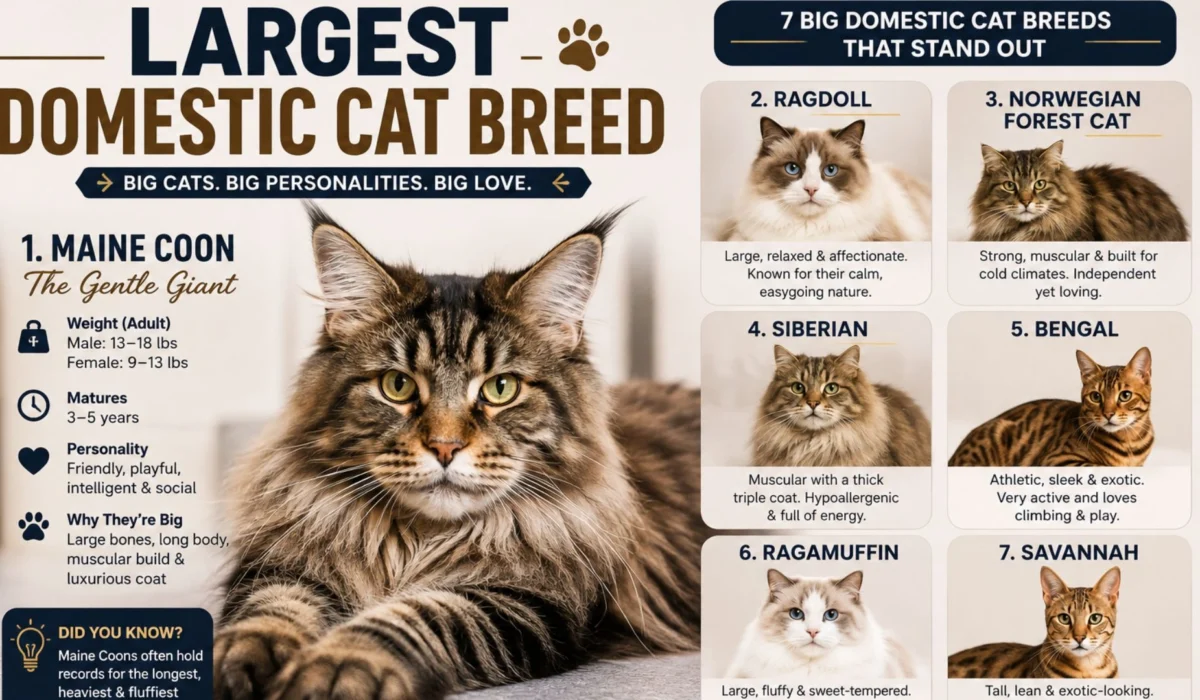
Largest Domestic Cat Breed in World: Top 7 Big Cats in 2026
If you’ve ever scrolled through cat videos and stumbled on a cat that looks more like a small dog, there’s a good chance you were looking at a Maine Coon. People searching for “big domestic cats” or “big house cat species” usually end up bumping into the same handful of names: Maine Coon, Ragdoll, Norwegian Forest Cat, Savannah. But there’s a real difference between a breed that tends to run large and one unusually big individual cat that happens to go viral.
For anyone shopping for a genuinely large, fully domesticated pedigree cat, the Maine Coon is really the obvious pick. According to TICA (The International Cat Association), mature males typically land somewhere around 13 to 18 pounds, with females usually a bit smaller at 9 to 13 pounds. And here’s the part a lot of first-time owners don’t expect these cats to take years, not months, to actually finish growing.
Let’s dig into what actually makes Maine Coons so big, which other breeds deserve a mention, and what you should think about before bringing one of these gentle giants home.
The Short Answer: It’s the Maine Coon
Ask any breed expert which cat wins the “largest domestic breed” title, and the Maine Coon cats come up almost every time.
Adult males commonly weigh in around 13–18 pounds, females around 9–13 pounds though, as with any living creature, individual cats can fall outside that range. Weight is only part of the story, though. Maine Coons also carry:
- Long, rectangular bodies
- Heavy, substantial bone structure
- Broad chests
- Big, tufted paws
- Long, plume-like tails
- Thick, semi-long coats
- Genuinely muscular builds
TICA’s official breed standard even calls out the substantial boning and broad chest as defining traits. And maturity? The standard allows for cats to keep filling out until they’re four or five years old which explains why a “kitten” that’s already a year old might still have a long way to go before it’s done growing.
Why Do Maine Coons Look So Enormous?
It’s not just a number on a scale.
- Their frame is naturally oversized: The long body, heavy bones, big paws, and sweeping tail all add up to a cat that reads as “big” the moment you see it even before you pick it up.
- Their coat does a lot of visual work: Stand a fluffy Maine Coon next to a short-haired housecat and the size gap looks dramatic, even when the actual weight difference isn’t as extreme as it appears.
- They take forever to grow up: Most cats hit their adult size within a year or so. Maine Coons? TICA pegs full maturity at around four years, with the breed standard allowing up to five. So don’t judge a young Maine Coon’s eventual size too early; there’s likely to be more cats coming.
Seven Big Domestic Cats Worth Knowing About
The Maine Coon may be the headliner, but it’s not the only large breed out there.
1. Maine Coon
The classic answer to “what’s the biggest housecat breed.” Known for a big frame, a long flowing tail, tufted paws, a semi-long coat, and a temperament that’s usually described as friendly, gentle, and playful well into adulthood.
2. Ragdoll
Large-bodied and semi-long-haired, Ragdolls tend to have a relaxed, easygoing personality, a good option for people who want size without a ton of extra energy to manage.
3. Norwegian Forest Cat
Bred for cold Scandinavian winters, these cats have a sturdy frame and a thick coat built for harsh weather. Like the Maine Coon, that coat makes them look even bigger than they are.
4. Siberian
Muscular and dense-coated, Siberians can look considerably larger than their actual weight suggests. They’re also fairly active, so climbing structures and playtime matter here.
5. Bengal
Less “massive,” more “athletic.” Bengals have a muscular, elongated build and a striking coat, but their real defining trait is energy. This is a breed for people who want an interactive, high-drive cat.
6. Ragamuffin
Big-bodied with a plush coat, Ragamuffins are usually described as affectionate and people-oriented, similar in spirit to their Ragdoll cousins.
7. Savannah
Savannahs need a bit of an asterisk. They’re a hybrid part domestic cat, part serval (a wild African cat). TICA does recognize them as a breed, but their wild ancestry sets them apart from the fully domestic breeds on this list.
That distinction matters a lot if you’re specifically searching for “big house cat species,” since a Savannah’s size and build aren’t really comparable to a traditional domestic breed like the Maine Coon.
“Big House Cat Species” vs. Large Domestic Breeds What’s the Difference?
Here’s a common point of confusion: a Maine Coon is not a different species from your average housecat. Every cat on this list Maine Coon, Ragdoll, Siberian, all of them is Felis catus, the same species as any other domestic cat. What sets them apart is breed and build, not biology.
That’s why it’s more accurate to search for things like “largest domestic cat breed” or “large pedigree cat breeds” rather than treating each big breed as its own species. The one real exception worth flagging is the Savannah, since its lineage genuinely does include a wild species, the serval.
How Big Can a Maine Coon Actually Get?
There’s no single ceiling that applies to every cat. TICA’s typical ranges 13–18 pounds for males, 9–13 for females are a starting point, not a hard rule. Genetics, sex, overall health, and body condition all play a role.
And weight alone can be misleading. A lean, long, muscular 17-pound Maine Coon is a very different animal from an overweight 17-pound cat carrying extra fat. Healthy proportions matter far more than hitting some maximum number, and a vet is a much better judge of that than a bathroom scale.
Record-Holding Maine Coons
This breed shows up again and again in the record books.
- Stewie (Mymains Stewart Gilligan) holds the Guinness World Record for longest domestic cat ever, measured at 123 cm (48.5 inches) nose to tail back in 2010.
- Barivel, another Maine Coon, measured 120 cm (about 3 ft 11 in) and held the record for longest living domestic cat back in 2018.
- Mr. Pugsley Addams, also a Maine Coon, set the record for longest tail on a living domestic cat at 46.99 cm (18.5 inches) in February 2025.
Fun facts, sure but not a benchmark to expect from your own pet. Record holders are exceptional individuals, not the norm.
Is a Big Cat Actually a Good Fit for Your Home?
Size shouldn’t be the deciding factor on its own. Before falling for one of these breeds, think through temperament, activity level, grooming needs, health considerations, and how much room you actually have.
- You’ll probably need bigger gear: Litter boxes, carriers, scratching posts, cat trees, beds, food and water stations. A standard-size setup that works fine for an average cat might be too small (or too flimsy) for a full-grown Maine Coon.
- They still need to move: Big doesn’t mean lazy. A sturdy cat tree, regular play sessions, and something to climb will keep a large cat both physically and mentally engaged.
- Grooming is part of the deal: Maine Coons have semi-long coats, and TICA suggests weekly combing is usually enough though some individual cats need more attention depending on coat texture and lifestyle. Starting the habit early makes life easier down the road.
Are Maine Coons Good With Families?
For a lot of households, yes. TICA describes the breed as generally sweet-tempered and sociable, and that reputation tends to hold up in real life. That said, personality still varies cat to cat. A big breed reputation isn’t a guarantee.
Worth thinking through before you commit:
- Your kids’ ages
- Other pets in the home
- How much space you actually have
- How much time you can give to interaction
- Your grooming bandwidth
- Access to veterinary care
- Your own experience with cats
A family wanting a calm companion should pick based on temperament, not just size. Someone hoping for a more active cat should look at the individual kitten’s personality rather than assuming bigger automatically means more energetic (or the opposite).
Picking a Maine Coon Kitten
Don’t just grab the biggest kitten in the litter size at eight weeks doesn’t tell you much about the adult cat it’ll become. Instead, ask the breeder about:
- The parents’ health and temperament
- Health screening and genetic testing
- Vaccination records
- Socialization so far
- Registration and pedigree paperwork
- Feeding guidance and expected care needs
A breeder worth working with should answer these questions without hesitation. If you’re exploring Maine Coon kittens specifically, Bella Dolce Maine Coons is a solid starting point for learning more about the breed, kitten care, and what to look for before bringing one home.
The goal isn’t the biggest kitten in the room, it’s a healthy, well-socialized one that actually fits your household.
Maine Coon vs. Other Big Domestic Cats
| Breed | What Makes It Large | Typical Personality |
| Maine Coon | Long body, heavy bone, long tail | Friendly, playful, sociable |
| Ragdoll | Large, substantial build | Relaxed, affectionate |
| Norwegian Forest Cat | Strong frame, thick coat | Active, adaptable |
| Siberian | Muscular, dense-coated | Active, interactive |
| Bengal | Athletic, muscular build | Energetic, playful |
| Ragamuffin | Large frame, plush coat | Affectionate, people-oriented |
| Savannah | Tall, athletic, hybrid ancestry | Active, needs careful consideration |
Keep in mind: breed profiles are a starting point, not a promise. Individual cats vary.
Bottom Line
If you’re after one of the big domestic cats, the Maine Coon is hard to beat an imposing build paired with a generally easygoing, friendly personality. The long body, heavy bones, big paws, flowing tail, and slow-motion growth spurt all add up to one of the most distinctive large breeds out there, and the record books back that up, from Stewie’s 48.5-inch frame to more recent tail-length titles.
Still, the biggest cat in the litter isn’t automatically the best cat for your home. If a Maine Coon is on your radar, weigh health, temperament, and long-term fit for your household before you weigh the cat itself. And if you’re specifically looking into kittens, Bella Dolce Maine Coons is a good place to start learning what goes into raising and choosing one of these cats well.
FAQ
What’s the largest domestic cat breed?
The Maine Coon, generally mature males around 13–18 pounds, females around 9–13 pounds, and take several years to reach full size.
What are the “biggest house cat species”?
Technically there’s just one species domestic cats are all Felis catus. “Large domestic cat breeds” is the more accurate term, and Maine Coon, Ragdoll, Norwegian Forest Cat, Siberian, Ragamuffin, Bengal, and Savannah are the usual names that come up.
Are Maine Coons really bigger than other domestic cats?
For the most part, yes their long bodies, heavy bones, big paws, and full tails put them at or near the top of the size list among traditional breeds.
How long until a Maine Coon is fully grown?
Slow and steady typically around four to five years before they’re truly done filling out.
Is the biggest Maine Coon the healthiest one?
Not necessarily. Good body condition, solid nutrition, veterinary care, sound temperament, and responsible breeding matter a lot more than raw size.
Also Read: Symptoms of Dead Kitten Inside a Cat