
Best Toys for Maine Coon Cats : A Complete 2026 Guide
Maine Coons are famous for their size, their friendly personalities, their intelligence, and how playful they stay well into adulthood. But because they’re bigger than your average cat and often keep acting like kittens long after they’ve stopped looking like one, picking the right toys takes a bit more thought than just grabbing whatever’s on the shelf at the pet store.
The best toys for a Maine Coon should hold up to real use, be sized appropriately for a genuinely large cat, keep their mind engaged, and encourage the natural behaviors they’re wired for chasing, stalking, pouncing, climbing, and figuring things out.
Maine Coons are one of the largest domestic cat breeds around. TICA describes them as large cats with substantial bone structure and a long, muscular body, and notes they tend to stay playful throughout their whole lives, often genuinely enjoying games like fetch.
Which means a tiny plastic ball or a flimsy feather toy probably isn’t giving your Maine Coon enough to actually work with.
Here’s a real look at the best toys for Maine Coons at every life stage, what actually makes a toy suited to this breed, and some practical tips for building a play routine that’s both safe and genuinely engaging.
What Actually Makes a Toy Good for a Maine Coon?
The short version: durable toys that lean into natural hunting instincts and real movement, sized appropriately for a cat that’s often noticeably bigger than average.
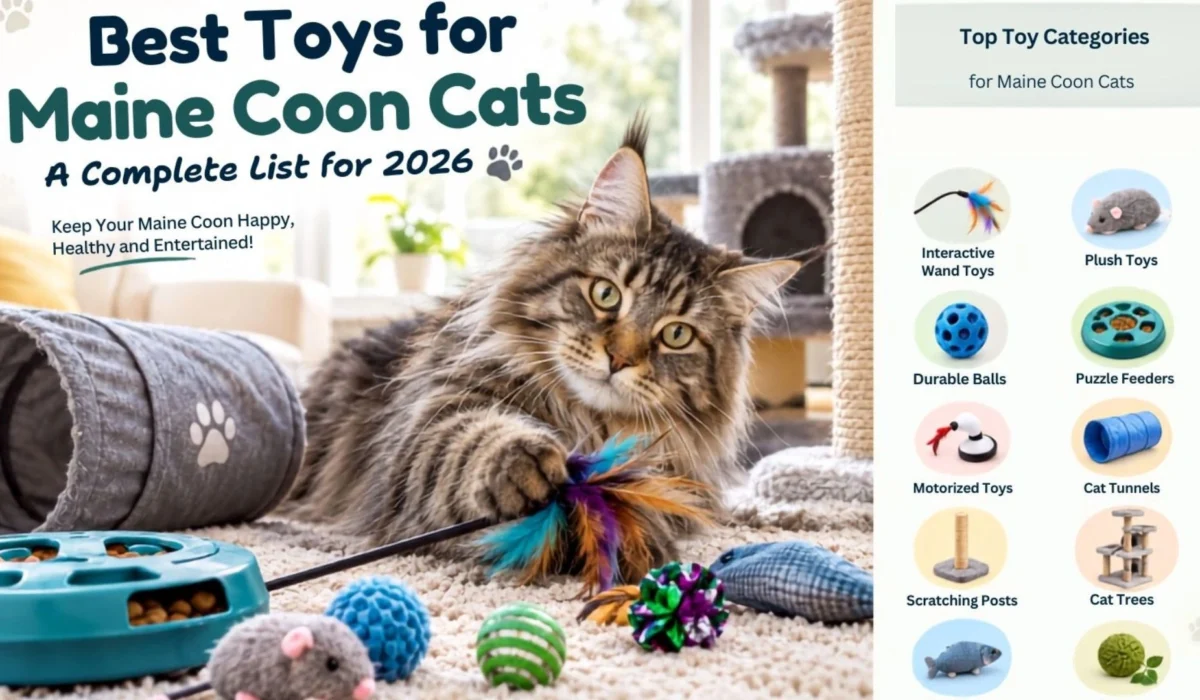
The most useful categories tend to be interactive wand toys, large plush mice, durable balls, puzzle and food-dispensing toys, motorized chase toys, tunnels, large scratching posts, sturdy cat trees, catnip toys, fetch toys, treat puzzles, and crinkle toys.
There’s no single toy every Maine Coon will love. Cats have real individual preferences. Some are all about chasing anything that moves. Others would rather bat a ball around the living room, or work a food puzzle for twenty minutes straight. Veterinary behavior guidance generally recommends offering a few different types and rotating them regularly VCA specifically suggests keeping only a handful of toys out at once and swapping the selection to keep things feeling fresh.
Why Maine Coons Genuinely Need a Bit More Variety?
Maine Coons aren’t just oversized versions of a regular house cat; their size and playful streak actually change what “enough enrichment” looks like.
TICA notes that Maine Coons are social, playful cats, and that plenty of them genuinely enjoy interactive toys, fetch, and even leash walking. A solid toy rotation should be covering a few different bases at once.
- Physical exercise: A big Maine Coon needs real room to run, jump, chase, and stretch interactive toys that can turn a few minutes into actual meaningful activity.
- Mental stimulation: Cats need to think, too. Puzzle feeders and treat toys tap into problem-solving and foraging instincts in a way a simple ball can’t.
- Hunting behavior: Stalking, chasing, pouncing, and “capturing” something that moves is baked into how cats operate. Toys that imitate prey make play a lot more engaging than static objects.
- Time with you: Some of the best Maine Coon toys are the ones you actually use together with wand toys and fetch games do double duty as exercise and bonding time.
Best Toys for Maine Coon Cats:
1. Interactive Wand Toys
These are among the best options out there, precisely because they let you imitate how prey actually moves.
Drag the toy across the floor. Let it vanish behind furniture for a second. Pause. Start it moving again. That kind of unpredictability gives your Maine Coon real opportunities to stalk and pounce, not just chase in a straight line.
Look for a wand with a strong handle, durable attachments, secure connections, enough reach to keep your hands safely away from claws, and replaceable attachments if possible.
Never leave a wand toy lying around when your cat’s unsupervised string and similar materials can turn genuinely dangerous if swallowed.
Best for: interactive play and real exercise.
2. Large Plush Mouse Toys
A Maine Coon needs toys it can actually grab and carry around, not something that disappears in one paw.
Large plush mice tend to work well here, letting cats practice grabbing and hauling around simulated prey, a very cat thing to want to do. Look for something large enough that it can’t be swallowed, strongly stitched, free of loose decorations that could come off, and easy to clean.
A simple plush mouse can end up being a genuine favorite, especially paired with a quick game of chase.
Best for: independent play, carrying, batting, and simulated hunting.
3. Durable Balls
Balls are a classic for a reason. Go for something lightweight but genuinely durable, and large enough that swallowing it accidentally isn’t a real risk.
Good options include textured plastic balls, crinkle balls, lightweight rubber-style cat balls, track balls, and large foam balls made specifically for pets. Skip anything tiny or anything that could break apart into smaller pieces.
A hallway makes a perfectly good play area just roll the ball away from your cat and let them go after it.
Best for: running, chasing, and independent play.
4. Puzzle Feeders and Treat Toys
Not every toy needs to involve running around the house. Puzzle toys make your Maine Coon actually work for food or treats, which can be especially useful once a cat’s gotten bored of the usual toys.
You can put a small portion of your cat’s regular food inside a suitable puzzle feeder, and they’ll have to figure out how to manipulate it to get the food out. Veterinary guidance genuinely backs food-based enrichment and foraging toys as a real form of mental stimulation just to make sure whatever you’re using is sized right and durable enough that your cat can’t chew off and swallow pieces.
Best for: mental stimulation and food-motivated cats.
5. Motorized Chase Toys
Some Maine Coons genuinely enjoy toys that move on their own, without needing you to control every second of the game. These can imitate the kind of unpredictable movement real prey has.
Look for options with multiple movement patterns, durable construction, automatic shutoff, cat-safe materials, and replacement parts where available.
That said, “motorized” doesn’t automatically mean “safe.” Check it regularly if your cat manages to chew pieces off, retire the toy.
Best for: independent activity when you’re nearby but busy with something else.
6. Cat Tunnels
A tunnel is a genuinely great addition to a Maine Coon’s play area. A lot of cats love running through them, hiding inside, and launching surprise ambushes on toys (or on you).
Size actually matters here for a Maine Coon specifically looking for a tunnel with a wide opening and enough interior room for your cat to move comfortably, not something built for a much smaller breed.
A simple game: drag a wand toy past the entrance and let your cat chase it straight through.
Best for: hiding, chasing, stalking, and interactive play.
7. Large Scratching Posts
Scratching isn’t just your furniture’s problem it’s a completely normal feline behavior your cat genuinely needs an outlet for.
A Maine Coon needs a scratching surface that can actually support real body weight. Look for something tall enough for a full-body stretch, heavy and genuinely stable, hard to knock over, covered in a material your cat actually likes, and placed somewhere your cat actually spends time.
A flimsy post that tips over every time your Maine Coon scratches it will get abandoned fast. Placing one near a sleeping spot tends to work well too, since cats often stretch and scratch right after waking up. The American Association of Feline Practitioners emphasizes giving cats real opportunities to express these natural behaviors as part of a healthy indoor environment.
8. Sturdy Cat Trees
For a breed this size, a cat tree needs a different standard than one built for a small kitten.
Look for wide platforms, strong support posts, genuinely stable construction, roomy sleeping areas, durable scratching surfaces, and multiple levels. A Maine Coon should be able to climb and rest on it without the whole thing wobbling underneath them.
You don’t necessarily need the tallest tree on the shelf stability and platform size matter a lot more than sheer height. Done right, a sturdy cat tree combines exercise, climbing, scratching, a good vantage point, and resting all in one piece of furniture.
9. Fetch Toys
A lot of people are surprised to learn Maine Coons genuinely enjoy fetch. TICA specifically notes many Maine Coons take to it naturally, and can even pick up simple commands when there’s a reward involved.
Start with a soft toy your cat already likes carrying around. Toss it a short distance. If they follow it, pick it up, or bring it back to you, reward that behavior. Plenty of Maine Coons end up developing their own personal version of the game over time.
Best for: bonding, exercise, and light training.
10. Catnip Toys
Catnip can make certain toys a lot more interesting for some cats, at least. Not every cat responds to it. VCA notes the response is largely genetic, and roughly half of cats may not react to catnip at all.
If your Maine Coon gets excited but stays relaxed and playful with it, catnip can be a genuinely useful bit of enrichment. If they get agitated instead, just switch to something else. Silvervine is worth trying if catnip’s a bust, though reactions to that vary from cat to cat too.
Best for: cats who respond well to scent-based enrichment.
Best Toys by Age
What works best genuinely shifts as your Maine Coon grows up.
Kittens. Look for toys that encourage safe movement and exploration soft balls, small-to-medium plush toys too big to swallow, supervised wand play, crinkle toys, simple puzzle feeders, and kitten-sized tunnels. VCA recommends several short play sessions rather than expecting a kitten to stay engaged for one long stretch; their attention (and energy) comes in bursts.
Adults. Grown Maine Coons can usually handle more of a challenge: large interactive toys, puzzle feeders, sturdy scratching posts, cat trees, motorized chase toys, fetch toys, larger tunnels, and interactive wands all tend to be a good fit.
Seniors. Older cats often still want to play, just at a gentler pace. Slow-moving toys, soft toys, food puzzles, gentle wand sessions, and comfortable scratching surfaces tend to work well. If you notice pain, stiffness, reluctance to jump, or a sudden shift in activity level, talk to your vet rather than chalking it up to “just getting older.”
How Often Should You Actually Play With a Maine Coon?
A good starting point: several short sessions spread across the day, rather than one long, exhausting one.
Something like: 10 minutes of wand play in the morning, a puzzle feeder or independent toy in the afternoon while you’re busy, 10–15 minutes of chasing and pouncing in the evening, and a shorter, calmer interactive session before bed followed by food or a quiet activity.
The right amount really depends on your cat’s age, health, personality, and general energy level. Indoor cats specifically benefit from real chances to hunt, forage, play, climb, scratch, and explore current AAFP guidance emphasizes that indoor cats need an environment genuinely built to support these instincts, not just a bowl and a bed.
Keeping Maine Coon Toys Actually Safe
Finding great toys isn’t only about keeping your cat entertained, safety has to come first. Before handing over a new toy, check:
- Could my cat swallow any part of it?
- Could it break into smaller pieces?
- Are there loose strings anywhere?
- Are feathers securely attached, or could they come loose?
- Could my cat chew straight through the material?
- Is it actually sized right for a cat this size?
- Could claws or teeth get trapped somewhere in it?
- Is it stable enough during actual use?
VCA specifically warns against leaving cats alone with wand or fishing-pole style toys, since strings and feathers can cause real problems if swallowed. Check toys regularly if a plush toy tears open or a plastic one develops sharp edges, it’s time to replace it.
Keeping the Toy Rotation Interesting
A common mistake: scattering twenty toys across the house and leaving them all out, all the time. Cats tend to eventually just stop noticing them.
Rotating instead keeps things fresh, something like wand, tunnel, balls, and a puzzle feeder one week; plush mouse, catnip toy, motorized toy, and a scratching toy the next; fetch toy, wand, puzzle feeder, and tunnel the week after that. This creates real novelty without needing to constantly buy new stuff.
Building a Maine Coon-Friendly Play Area
A good setup doesn’t have to be expensive. A simple enrichment zone might include a sturdy scratching post, a stable cat tree, a tunnel, a handful of rotating toys, a puzzle feeder, and a comfortable spot to rest.
Spread some toys on the floor and place others up near the climbing areas. If your Maine Coon likes watching birds through a window, a secure perch nearby is worth setting up too.
If you’re bringing a Maine Coon kitten into your home, choosing an environment that actually supports play and healthy social development matters just as much as picking the right toys. Bella Dolce Maine Coons focuses on raising kittens in a home setting with real socialization and safe opportunities to be active worth a look if you’re preparing to welcome a new kitten and want to see how that kind of environment gets built.
A Simple Daily Routine to Start With
- Morning. Ten or so minutes of interactive wand play, letting your cat chase and eventually actually catch the toy.
- Afternoon. A safe independent toy or puzzle feeder left out for mental stimulation while you’re busy with your own day.
- Evening. Another interactive session wand, tunnel, or a round of fetch.
- Before bed. Wind down with something calmer.
None of this needs to be rigid; let your cat’s actual behavior guide the pace. If they get tired, disengage, or just wander off, that’s your cue the session’s done.
Toys Worth Avoiding
Skip leaving these unattended, ever: loose string, yarn, ribbon, fishing-line style toys, loose feathers, rubber bands, hair ties, very small balls, or anything with detachable pieces.
String and similarly thin, linear objects can cause genuinely serious intestinal problems if swallowed; this isn’t a minor risk to shrug off.
Also worth avoiding: using your own hands or feet as toys. A tiny kitten batting at your fingers is cute. A full-grown Maine Coon with real jaw strength and claws doing the same thing is a different story entirely. It’s worth teaching early on that toys are for hunting and hands are for affection, not the other way around.
Choosing What Actually Works for Your Cat
The best toys for a Maine Coon aren’t necessarily the priciest ones on the shelf. They’re the ones that safely tap into natural feline behavior while genuinely matching your cat’s size, personality, and energy level.
Start small with a handful of quality picks: one interactive wand, one durable ball, one large plush toy, one puzzle feeder, one tunnel, one sturdy scratching post, and one stable cat tree. Then just watch what your particular Maine Coon actually gravitates toward.
Some cats will chase a feather for ten straight minutes. Others would rather haul a plush mouse around the house all evening. Some will happily work a food puzzle; others would clearly rather play fetch. There’s no universal answer here, just your specific cat’s preferences.
The real goal isn’t filling your house with toys. It’s creating genuine opportunities for movement, hunting, exploration, problem-solving, scratching, and time spent together.
If you’re bringing a Maine Coon kitten into your family, it’s worth starting to build that environment from day one alongside picking the right toys, it’s worth learning about grooming, feeding, general health care, and kitten training too, so your new kitten grows into a confident, well-adjusted companion.
At the end of the day, the best toy is simply the one that gets your Maine Coon wanting to play, think, explore, and engage with you safely, and on their own terms.
FAQ
What are actually the best toys for Maine Coon cats?
Durable interactive toys, large plush toys, sturdy balls, puzzle feeders, tunnels, scratching posts, and stable cat trees. The best specific pick really depends on your individual cat’s play style.
Do Maine Coons genuinely need special toys?
Not breed-specific ones exactly, but because they’re large and tend to stay playful well into adulthood, sizing and durability matter more than they might for a smaller breed. TICA describes them as large, muscular, social, and genuinely playful cats.
Do Maine Coons actually like interactive toys?
Most do they’re generally social and playful by nature. Interactive toys give them real exercise while giving you a genuine chance to bond with them.
How often should toys actually get replaced?
Whenever one gets damaged, develops sharp edges, loses pieces, or becomes small enough that a piece could be swallowed. Even genuinely durable toys deserve a regular once-over.
Can Maine Coons play with string toys?
Only under direct supervision, with wand-style toys specifically. String should never be left where your cat can access it alone; swallowing it can lead to serious intestinal complications.
Also Read: Maine Coon vs Siberian Cat