

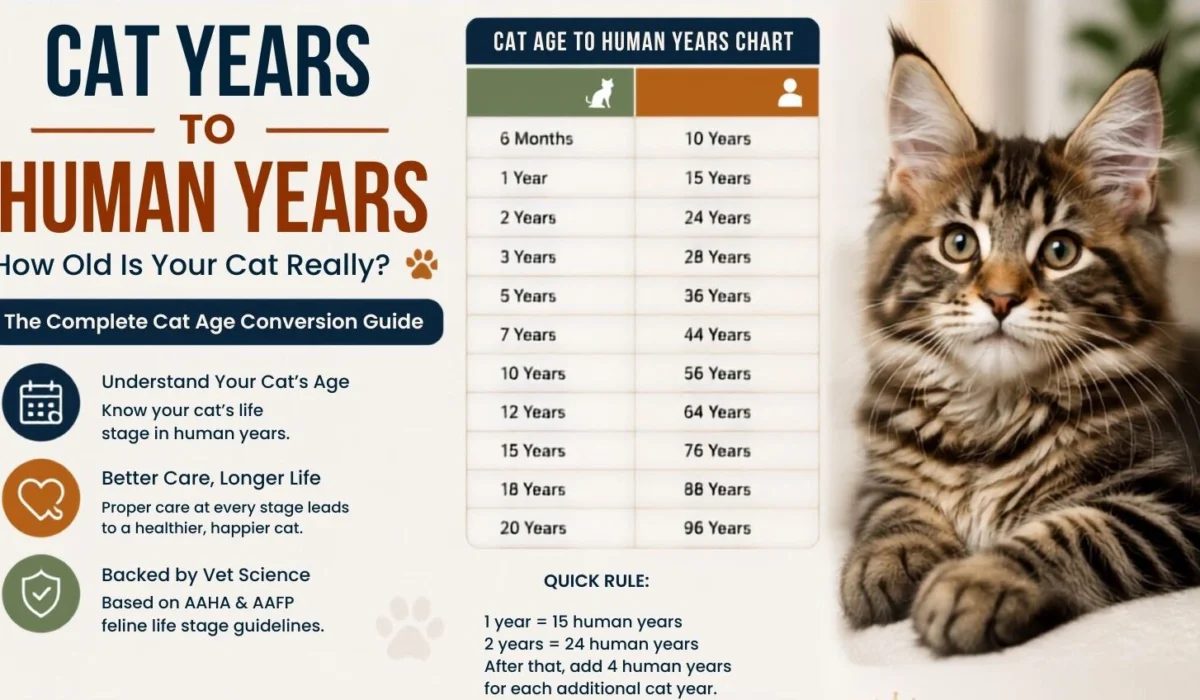
Cat Years to Human Years: Complete Cat Age Conversion Tips
If you’ve ever watched your cat sprawled out on the couch and thought, “how old is this guy actually, in people years?” you’re far from the only one. Cats pack an enormous amount of aging into their first couple of years, which is exactly why the old “multiply by seven” trick never quite adds up.
Figuring out the real cat-years-to-human-years comparison gives you a much better sense of where your cat actually stands in life. It’s also genuinely useful, because it can help you notice when it’s time to rethink nutrition, activity levels, dental care, or how often your cat should be seeing the vet.
Here’s the short version: a one-year-old cat is roughly like a 15-year-old human. By age two, that climbed to about 24. After that, every extra cat year adds around four human years. This isn’t a random rule of thumb; it lines up with figures used by the American Animal Hospital Association (AAHA), the American Association of Feline Practitioners (AAFP), and VCA Animal Hospitals.
So if you’ve been hunting for a cat age chart or a quick way to do the math yourself, here’s how it actually works.
Why Cats Don’t Age at a Steady Rate?
Cats don’t age on some smooth, constant curve. The first two years are where almost all the drama happens.
A kitten develops at a startling pace, both physically and socially. By its first birthday, it’s already roughly comparable to a human teenager. By year two, it landed somewhere closer to a young adult. After that point, though, the math settles down considerably.
The commonly used veterinary shorthand goes like this:
- 1 cat year ≈ 15 human years
- 2 cat years ≈ 24 human years
- Every cat year after that ≈ 4 human years
So a three-year-old cat comes out to roughly 28 in human years. A 10-year-old cat lands around 56. An 18-year-old cat works out to about 88. This tracks with the general comparison used in AAHA’s own chart.
It also explains why the popular “one cat year equals seven human years” idea is more myth than math cats simply don’t age on that kind of even, linear schedule.
A Cat Age Chart You Can Actually Use
Here’s a simple breakdown based on the AAHA/AAFP life-stage comparison:
| Cat’s Age | Approximate Human Age |
| 6 months | 10 years |
| 1 year | 15 years |
| 2 years | 24 years |
| 3 years | 28 years |
| 4 years | 32 years |
| 5 years | 36 years |
| 6 years | 40 years |
| 7 years | 44 years |
| 8 years | 48 years |
| 9 years | 52 years |
| 10 years | 56 years |
| 11 years | 60 years |
| 12 years | 64 years |
| 13 years | 68 years |
| 14 years | 72 years |
| 15 years | 76 years |
| 16 years | 80 years |
| 17 years | 84 years |
| 18 years | 88 years |
| 19 years | 92 years |
| 20 years | 96 years |
Worth remembering: these are estimates, not a precise biological conversion, and different veterinary sources land on slightly different numbers. Cornell, for instance, puts a one-year-old cat closer to 16 in human terms and a two-year-old closer to 21, then applies roughly the same four-years-per-year rule after that.
The specific numbers matter less than the overall shape of the curve: cats age extremely fast in their first couple of years, then settle into a much slower, steadier pace.
Doing the Math Yourself
You really don’t need a fancy calculator for this.
- One-year-old cat → about 15 human years
- Two-year-old cat → about 24 human years
- Anything older than two → 24 + 4 × (cat’s age − 2)
Say your cat just turned eight. That’s 24 + 4 × (8 − 2) = 24 + 24 = 48 human years.
Or a 12-year-old cat: 24 + 4 × (12 − 2) = 64 human years.
It’s a handy quick formula, but keep in mind it’s still an approximation breed, genetics, health, nutrition, and lifestyle all shape how any individual cat actually ages.
Life Stage Matters More Than the Number Does
The human-age comparison is fun to calculate, but vets generally care more about life stage than the exact number.
The 2021 AAHA/AAFP feline guidelines break a cat’s life into a few broad categories:
- Kitten: birth to 1 year
- Young adult: 1 to 6 years
- Mature adult: 7 to 10 years
- Senior: over 10 years
- End of life: can happen at any age
These stages matter because health priorities shift as cats get older. And importantly, the guidelines are clear that these categories aren’t set in stone. Two cats the exact same age can be in wildly different shapes.
An 11-year-old cat might still be bouncing off the walls and playing like a much younger animal, while another cat that age might already be dealing with dental issues, kidney problems, weight changes, or trouble getting around. In other words, the chart is a guide, not a diagnosis.
Why Is the Human-Age Comparison Actually Useful?
Putting your cat’s age in human terms can make its life stage click in a way raw cat-years never quite do.
Take a one-year-old cat; it might still look small next to a full-grown adult, but physiologically it’s already well past the equivalent of a human child.
By age seven, your cat is sitting around 44 in human years. That’s usually a good point to start paying closer attention to shifts in weight, energy, dental health, and general behavior. And once a cat crosses 10, veterinary guidelines start classifying it as senior which doesn’t automatically mean something’s wrong, just that age-related risks deserve a bit more watchfulness.
For cats in that mature-to-senior range, vets tend to keep an eye out for things like:
- Chronic kidney disease
- Hyperthyroidism
- Diabetes
- Dental disease
- Arthritis
- Cancer
- Cognitive changes
AAHA/AAFP guidance recommends adjusting checkups and care plans as your cat moves through these different stages, rather than sticking with the same routine forever.
So, How Long Do Cats Actually Live?
There’s no single answer that applies across the board. VCA puts the average lifespan of an indoor cat somewhere around 16 to 18 years, with plenty of cats living well past 20. Cornell notes something similar hitting 20 or 21 isn’t the rarity it once was, thanks to better nutrition, veterinary care, and general home care.
An 18-year-old cat, using the chart above, comes out to roughly 88 in human years. A 20-year-old cat lands around 96. Numbers like that are a good reminder that responsible cat care isn’t just about getting a kitten safely through its first year. Good nutrition, preventive vet visits, dental care, weight management, and parasite control all add up to a longer, healthier life over the long haul.
Does Staying Indoors Actually Extend a Cat’s Life?
If your cat’s strictly indoors, you might be wondering whether that changes the math at all.
Indoor living does cut out a lot of risk traffic, fights with other animals, certain infectious diseases, and various outdoor hazards all drop out of the picture. VCA’s 16-to-18-year average lifespan figure reflects that, along with the note that plenty of indoor cats sail past 20.
That said, staying indoors alone isn’t a guaranteed ticket to a long life. Indoor cats still need regular vet checkups, a balanced diet with reasonable portion control, daily activity, dental care, parasite prevention when it’s called for, mental stimulation, fresh water, and a safe, comfortable space to live in. AAHA/AAFP guidelines recommend at least an annual exam for cats, with more frequent monitoring as they get older and their individual needs shift.
Does Breed Change Math?
The basic conversion works across cats generally, but breed and individual health can still nudge things one way or another.
Maine Coons, for example, are known for their large size and distinctive look, and their care needs can differ somewhat from smaller breeds. If you’re caring for one or thinking about it, a resource like Bella Dolce Maine Coon can be genuinely useful for breed-specific guidance on nutrition, grooming, activity, and long-term care.
That said, breeding alone won’t tell you exactly how long a particular cat will live. Genetics, preventive care, environment, weight, and overall health all play a role too.
Signs Your Cat Is Aging the Way It Should?
A chart only tells part of the story. The rest comes from actually paying attention to your cat’s day-to-day habits.
Keep an eye out for things like:
- Less jumping or climbing than usual
- Changes in appetite
- Drinking noticeably more or less water
- Shifts in litter-box habits
- Weight gain or loss
- Poor grooming
- Bad breath
- Sleeping a lot more than normal
- Confusion or changes in how your cat interacts with you
- Trouble walking
- General behavior changes
Some of this is a completely normal part of aging. Other changes can point to something that needs a vet’s attention.
Cats are notoriously good at hiding illness, which is exactly why you shouldn’t wave off a noticeable change as “just getting old” without checking in with a professional first. A vet can actually tell the difference between expected aging and something that needs treatment.
How Accurate Is a Cat Age Calculator, Really?
A calculator like the one above gives you a solid approximate human-age equivalent, but it can’t measure your cat’s actual biological age.
Two cats can both be 12 years old; one might still be sprinting around the house in great shape, while the other is quietly dealing with kidney disease or arthritis. That’s exactly why vets treat life-stage categories as a useful starting point rather than the whole picture; individual variation can be significant.
Use the calculator to get a sense of where your cat stands in life. Use actual veterinary care to find out how your cat is really doing.
The Bottom Line
Understanding cat years to human years is a simple way to put your cat’s age into real perspective. A one-year-old cat is already roughly comparable to a human teenager, and a two-year-old is closer to a 24-year-old. From there, every extra year adds about four human years to the tally.
But the number is really just the starting point. Your cat’s breed, genetics, lifestyle, nutrition, weight, environment, and the care it receives all shape how it actually ages a healthy 15-year-old cat can still be living a full, comfortable, active life.
Use a chart or quick calculation as a jumping-off point. Then let your cat’s actual behavior, physical condition, and regular vet checkups tell you what it really needs. Knowing your cat’s age in human terms isn’t just a fun fact to share, it’s a genuinely useful way to notice when your companion is stepping into a new stage of life, and when it might be time to adjust how you’re caring for them.
FAQ
How old is a 1-year-old cat in human years?
Around 15 human years, based on the commonly used AAHA comparison.
How old is a 2-year-old cat in human years?
About 24 human years. From this point on, each additional cat year adds roughly four human years.
How old is a 10-year-old cat in human years?
Around 56 human years and by current AAHA/AAFP guidelines, that puts your cat right at the edge of the senior life stage.
What’s the average lifespan of an indoor cat?
Typically estimated at 16 to 18 years, though plenty of cats live well past 20.
Is 15 old for a cat?
A 15-year-old cat works out to roughly 76 human years generally considered senior or geriatric, depending on which framework you’re using. Age on its own isn’t a disease, but older cats do benefit from closer monitoring.
Also Read: Largest Domestic Cat Breed in World