

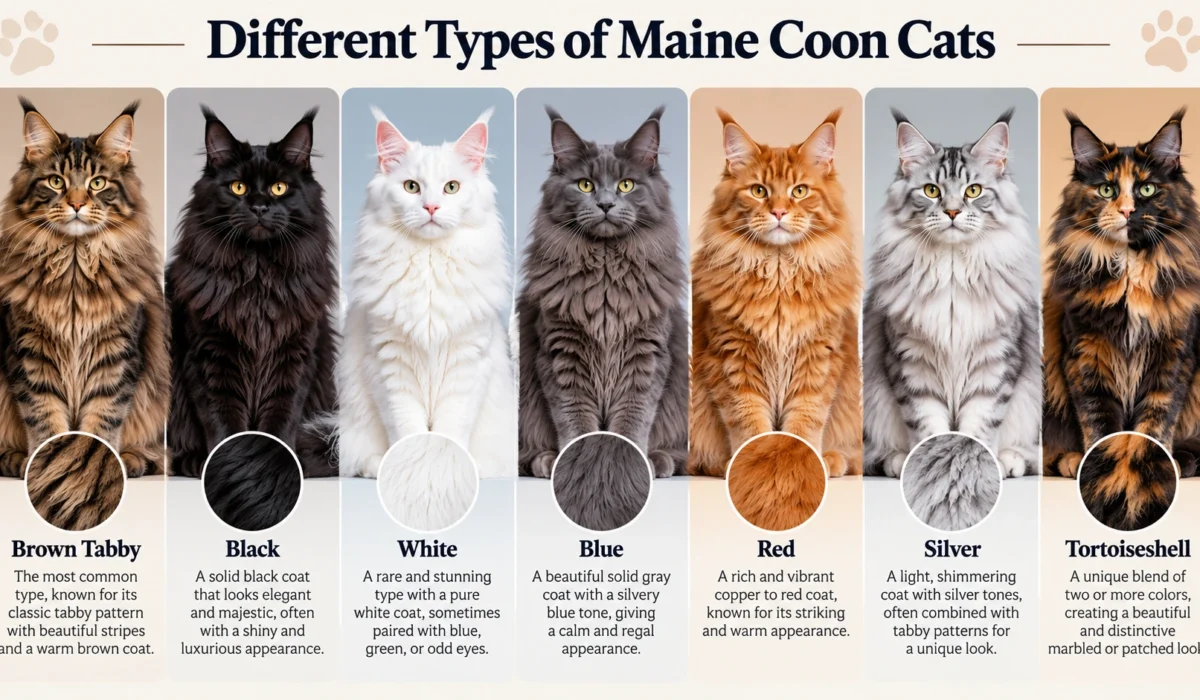
Different Types of Maine Coon Cats: 11 Colors & Patterns
Maine Coons are famous for their impressive size, long flowing coats, tufted ears, and friendly personalities. But did you know that these cats come in many different colors and coat patterns? From a classic brown tabby to a striking silver Maine Coon or a black-and-white bicolor, each cat can have a distinctive appearance.
When people search for the different types of Maine Coon cats, they are usually looking for differences in coat color, markings, size, or physical appearance. However, these variations do not necessarily mean that the cats belong to different breeds.
The International Cat Association (TICA) recognizes a broad range of Maine Coon colors and patterns. The breed’s familiar characteristics remain the same despite these visual differences.
In this guide, we will explore the different kinds of Maine Coon cats, explain their most recognizable colors and patterns, discuss common myths, and share practical advice for choosing a healthy kitten.
Are There Different Types of Maine Coon Cats?
There is one main Maine Coon breed, but there are many accepted coat colors and patterns. People sometimes use terms such as American Maine Coon, European Maine Coon, and traditional Maine Coon to describe differences in appearance or breeding lines.
These labels are commonly used by breeders and enthusiasts. They should not automatically be treated as officially recognized separate breeds.
The Cat Fanciers’ Association (CFA) describes the Maine Coon as a solid, rugged cat with a distinctive shaggy coat and a balanced appearance. Its breed standard evaluates the head, ears, eyes, body, coat, and color.
The most useful way to understand the different types of Maine Coon cats is to look at three areas:
- Coat color: The main color of the cat’s fur.
- Coat pattern: The arrangement of stripes, patches, or shading.
- Physical characteristics: Features such as body shape, ear tufts, coat length, and tail.
These differences help explain why two purebred Maine Coons can look quite different while sharing the same breed characteristics.
1. Brown Tabby Maine Coon
The brown tabby is one of the most recognizable Maine Coon appearances. TICA identifies the brown classic or mackerel tabby as the breed’s most common color and pattern combination.
Brown tabby Maine Coons typically have a warm brown or copper-toned background with darker markings.
Depending on the pattern, those markings may form bold swirls, narrow stripes, or finer lines along the body and legs.
What makes them distinctive?
- Brown or copper-toned fur
- Dark markings around the face and body
- A striped or swirling pattern
- A thick tail that may show dark rings
A brown tabby Maine Coon can be a great choice for people who appreciate the breed’s traditional, wild-looking appearance.
Remember that coat color alone does not tell you whether a cat is healthier, friendlier, or more intelligent than another Maine Coon.
2. Red or Orange Maine Coon
Red Maine Coons are often called orange or ginger cats. Their coats can range from a rich reddish shade to a lighter orange or cream-like appearance.
Red Maine Coons may have a solid-looking coat or a tabby pattern. Many have visible stripes on their legs, face, and tail.
Their warm coloring can make the long coat look especially vibrant in natural light.
A red Maine Coon may also have white markings on the chest, paws, or face, depending on its color combination.
When comparing different kinds of Maine Coon cats, remember that red is a coat color, not a separate breed.
3. Silver Maine Coon
Silver Maine Coons are popular because their coats can create a dramatic contrast between light fur and darker markings.
A silver tabby generally has a pale silver background with darker markings. The exact look depends on the pattern and the amount of shading.
Silver Maine Coons may display:
- Silver tabby markings
- Silver-and-white coloring
- Dark markings over a pale undercoat
- Different levels of contrast across the face and body
TICA recognizes silver-pattern combinations among Maine Coons. These include black-silver, blue-silver, red-silver, and cream-silver variations.
If you are comparing Maine Coon kittens, ask the breeder how the kitten’s coat is expected to develop. Young kittens can change in appearance as their adult coats come in.
4. Black Maine Coon
A black Maine Coon has a coat that appears predominantly black, often giving the cat a dramatic appearance.
A solid black Maine Coon may have dark fur from the roots toward the tips. In suitable lighting, the coat may reveal subtle brown or charcoal tones.
These cats still have the same signature Maine Coon features, including a long tail, substantial body, and shaggy coat.
It is important to distinguish a solid black Maine Coon from a black smoke Maine Coon. A smoke coat has a lighter undercoat that becomes visible when the fur moves or parts.
The difference comes from the coat’s color distribution, not from the cat belonging to another breed.
5. White Maine Coon
White Maine Coons have predominantly white coats and can look particularly striking against their large ears and long fur.
Their eyes may be gold, green, blue, or a combination, depending on the individual cat and its genetics. TICA notes that blue and odd-colored eyes are permissible in white Maine Coons and certain cats with white markings.
White cats should not be judged by appearance alone when it comes to health. Congenital hearing loss is associated with some white-cat genetics, particularly in blue-eyed white cats. This does not mean that every white Maine Coon is deaf.
Ask the breeder about appropriate veterinary screening and hearing concerns where relevant.
6. Blue or Gray Maine Coon
A blue Maine Coon is not actually blue like the sky. In cat-coat terminology, “blue” refers to a diluted gray shade.
The coat may look slate gray, smoky gray, or blue-gray depending on lighting.
Blue Maine Coons can also have white markings or tabby patterns. Some may appear almost solid gray, while others have more visible variations across the coat.
Their cool-toned coloring creates a different look from the warm brown and red varieties.
When browsing the different types of Maine Coon cats, look at the underlying coat color and its pattern rather than relying solely on photographs. Lighting and camera settings can make the same shade appear different.
7. Cream Maine Coon
Cream Maine Coons have a soft, pale coat that may resemble light peach, buff, or warm ivory. Cream coloring is a diluted form of red. It can occur in solid-looking coats, tabby patterns, or combinations with white.
Cream Maine Coons often have a subtle appearance because their markings may be less pronounced than those of darker cats.
As with other colors, cream is a cosmetic variation. It does not indicate a separate Maine Coon breed or guarantee a particular temperament.
8. Tortoiseshell Maine Coon
Tortoiseshell Maine Coons have a mix of two main coat colors, usually black and red, with the colors appearing in patches or intermingled across the body.
Some have bold, clearly separated patches. Others display a more blended mixture of dark and warm colors.
Blue-cream is a related color combination that uses diluted blue-gray and cream shades.
Most tortoiseshell cats are female because the genetics controlling red and black coloring are linked to the X chromosome. Male tortoiseshell cats are possible but uncommon.
Tortoiseshell describes a coat pattern, not a separate breed.
9. Calico Maine Coon
Calico Maine Coons typically have three visible colors: white, black, and red or orange. Dilute calicos have softer combinations of white, blue-gray, and cream.
Unlike a tortoiseshell coat, which often has intermingled colors, a calico usually shows more distinct patches with white playing an important role in the overall appearance.
No two calico coats look exactly alike. One cat may have large patches on its back, while another may have a more balanced mix of colors across its face and body.
Calico is another color pattern rather than a separate Maine Coon breed.
10. Smoke and Shaded Maine Coons
Smoke and shaded coats can look similar in photographs, but they describe different distributions of color.
Smoke Maine Coons generally have darker outer fur with a much lighter undercoat. When the cat moves or its long coat parts, the pale base can become visible.
Shaded Maine Coons usually have more gradual color tipping, creating a lighter overall appearance with darker shading across selected areas.
These coat effects can look especially striking on a long-haired cat because movement reveals different layers of fur.
The CFA recognizes specific shaded and smoke color classes within its Maine Coon standard.
If you are interested in one of these appearances, ask the breeder to explain the kitten’s registered color description rather than relying only on a casual label.
11. Bicolor and Tabby-and-White Maine Coons
Some Maine Coons have white fur combined with another color or pattern. These cats may be described as bicolor, tabby-and-white, or by a more specific color designation.
Common appearances include:
- Black and white
- Red and white
- Blue and white
- Brown tabby and white
- Silver tabby and white
White markings may appear on the chest, belly, paws, face, or other areas of the body.
TICA notes that many Maine Coon colors and patterns can appear with white markings, which are classified as particolor.
This variety allows for many different appearances without changing the cat’s underlying breed identity.
Are American and European Maine Coons Different Breeds?
You may see breeders or online articles referring to American and European Maine Coons.
These descriptions often refer to differences in breeding lines, head shape, muzzle appearance, body development, or the overall look favored by particular breeders.
However, it is misleading to assume that American and European Maine Coons are separate breeds with entirely different characteristics. Both labels generally refer to Maine Coons, and individual cats can vary considerably.
A responsible breeder should focus on the breed standard, temperament, health screening, and sound structure rather than simply advertising an exaggerated appearance.
TICA and CFA breed standards emphasize balanced Maine Coon characteristics. CFA specifically states that quality should not be sacrificed for size.
Do Different Types of Maine Coon Cats Have Different Personalities?
Not necessarily. A black Maine Coon is not automatically calmer than an orange Maine Coon. A silver tabby is not inherently more playful than a white cat.
A cat’s behavior is influenced by genetics, early socialization, environment, health, and individual temperament. Coat color alone is not a reliable way to predict personality.
Maine Coons are often described as social, intelligent, playful, and people-oriented. However, every cat is an individual.
When meeting a kitten, pay attention to whether it appears alert and responsive. Ask the breeder how the kitten has been socialized and how it responds to ordinary household activity. A good match is about temperament and care as much as appearance.
How to Choose the Right Maine Coon Kitten?
With so many colors and patterns available, it is easy to focus entirely on the kitten’s appearance. But responsible selection requires more than choosing a favorite coat.
Before bringing home a Maine Coon, consider the following.
- Ask about health screening: Maine Coons can be affected by inherited conditions, including hypertrophic cardiomyopathy (HCM). TICA recommends responsible screening that can include genetic testing and periodic echocardiograms evaluated by a board-certified veterinary cardiologist. Genetic testing alone cannot identify every possible cause of HCM.
- Learn about the kitten’s upbringing: Ask about socialization, veterinary care, feeding, and the environment where the kitten has been raised.
- Review the breeder’s records: Reputable breeders should be willing to discuss health testing, the kitten’s parents, vaccination history, and the purchase process.
- Prepare your home: Maine Coons need suitable food, scratching opportunities, interactive play, grooming, and comfortable resting spaces.
- Choose for the long term: Consider personality, household needs, ongoing grooming, and veterinary expenses along with color and appearance.
At Bella Dolce Maine Coon, we believe prospective owners should understand the responsibilities that come with bringing home one of these distinctive cats.
Our Maine Coon kittens page is a useful starting point for families exploring available kittens. You can also read our complete Maine Coon kitten care guide to learn about feeding, socialization, grooming, and helping a kitten settle into a new home.
FAQ
What are the most common types of Maine Coon cats?
Maine Coons come in numerous coat colors and patterns. Common examples include brown tabby, red, black, white, blue, cream, silver tabby, tortoiseshell, calico, smoke, and bicolor. These are coat variations within the breed rather than separate breeds.
What is the rarest Maine Coon color?
There is no single universally accepted ranking of the rarest Maine Coon colors. Availability depends on genetics, breeding programs, and location. Be cautious of sellers who use words such as “rare” or “exclusive” to justify a high price without providing health records and credible breeding information.
Are European Maine Coons bigger than American Maine Coons?
Not necessarily. These labels do not guarantee a particular size or body type. Individual genetics, sex, age, health, and breeding lines all contribute to variation. A breeder should prioritize healthy development and balanced structure over extreme size.
Does a Maine Coon’s color affect its personality?
There is no reliable rule that a particular Maine Coon coat color determines personality. Socialization, genetics, health, and individual temperament are more useful considerations when choosing a companion.
Final Thoughts
The different types of Maine Coon cats are best understood through their coat colors, patterns, and individual physical characteristics rather than as separate breeds.
Brown tabby, silver, red, black, white, blue, cream, tortoiseshell, calico, smoke, and bicolor Maine Coons each offer a distinctive appearance. Yet the features that define the breed remain more important than color alone.
If you are considering a Maine Coon, look beyond the coat. Ask about health screening, temperament, early socialization, and responsible breeding practices.
At Bella Dolce Maine Coon, we encourage prospective owners to choose a companion based on health, individual personality, and a good fit for their household. A beautiful coat may catch your eye, but thoughtful care and a responsible start help build a lasting relationship with your cat.
Also Read: Rabies Vaccine for Cats