

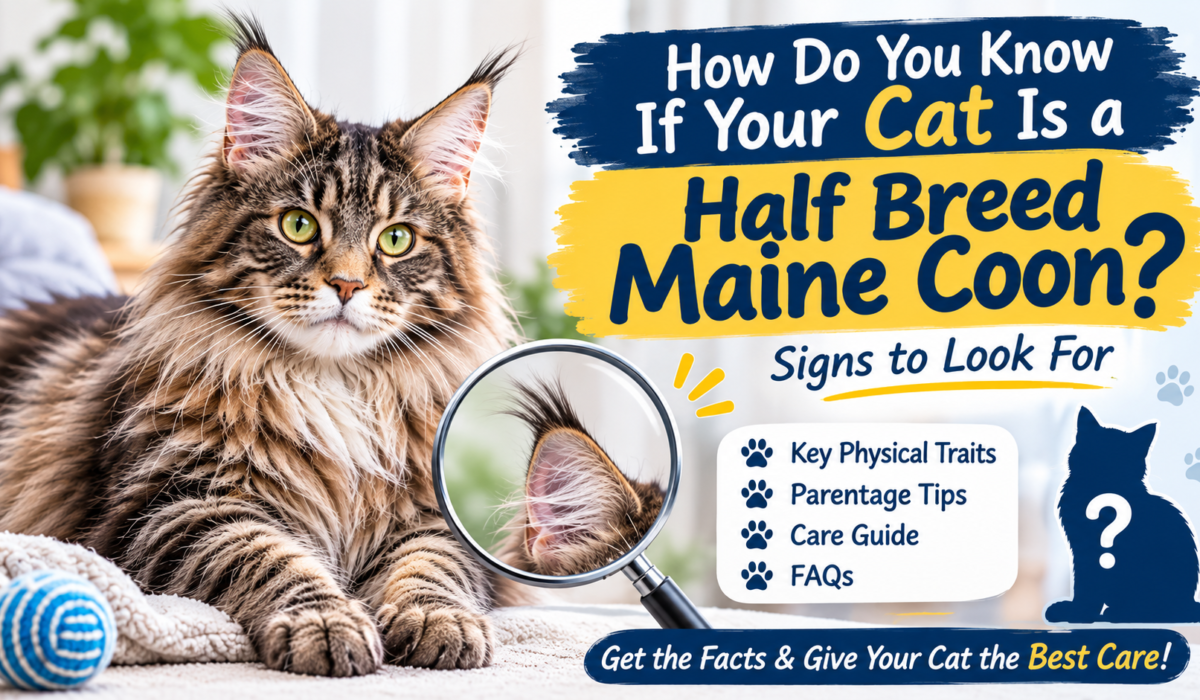
Half Breed Maine Coon: 7 Signs & How to Identify Your Cat
Have you ever looked at your cat’s large paws, fluffy tail, and impressive coat and wondered whether it might be part Maine Coon? You are not alone. Many cat owners notice similarities between their pets and this popular large cat breed.
A half breed Maine Coon is generally a cat with one Maine Coon parent and one parent from another breed or mixed background. These cats may inherit some of the Maine Coon’s recognizable physical features. However, they do not always look exactly like a purebred Maine Coon.
The challenge is that several other domestic cats naturally have long coats, large bodies, tufted ears, and bushy tails. So, how do you know if your cat is a half Maine Coon cat?
In this guide, we will explore the key physical traits to look for, explain how genetics and parentage affect appearance, and discuss the most reliable ways to understand your cat’s background.
What Is a Half Breed Maine Coon?
A half breed Maine Coon is commonly used to describe a mixed-breed cat with one purebred Maine Coon parent and one parent that is not a purebred Maine Coon.
For example:
- A purebred Maine Coon mother and a domestic longhair father.
- A purebred Maine Coon father and a domestic shorthair mother.
- A Maine Coon parent crossed with another recognized cat breed.
In a first-generation cross where one parent is a documented purebred Maine Coon, the kitten is generally described as having one-half Maine Coon pedigree ancestry.
However, this does not mean the kitten will inherit exactly half of the Maine Coon’s visible characteristics.
Genetics are more complicated than appearance. Kittens inherit different combinations of genes from their parents. One may have a long coat and bushy tail, while another from the same litter may have shorter fur and a different body shape.
It is also important to understand that “half breed” is an informal description rather than a separate officially recognized Maine Coon breed.
7 Key Physical Traits to Look For in a Half Breed Maine Coon
Physical characteristics can help you identify similarities to the Maine Coon breed. However, no single trait proves that a cat has Maine Coon ancestry.
Look for a combination of features rather than relying on one distinctive characteristic.
1. Large Body and Rectangular Shape
Maine Coons are known for their large and muscular bodies. A typical Maine Coon has a substantial frame with a broad chest, strong legs, and a long rectangular body.
A half breed Maine Coon may inherit some of these characteristics.
You might notice:
- A longer-than-average body.
- Strong shoulders and hindquarters.
- A broad chest.
- Solid bone structure.
- Large paws.
- A substantial overall appearance.
However, size alone is not reliable evidence. Some domestic cats are naturally large, while some genuine Maine Coon mixes remain relatively small.
TICA explains that Maine Coons develop slowly and may not reach full physical maturity until approximately three to five years of age.
This means a young cat may not yet display the body proportions associated with a mature Maine Coon.
2. Long and Bushy Tail
The Maine Coon’s tail is one of its most recognizable features. A typical purebred Maine Coon has a long, flowing, bushy tail that balances its substantial body.
A Maine Coon mix may inherit:
- A long tail.
- Thick fur around the tail.
- A fuller appearance toward the tip.
- A noticeable plume-like shape.
Look at the tail alongside the cat’s other physical characteristics. A fluffy tail by itself does not confirm Maine Coon ancestry because many domestic longhair cats also have impressive tails.
3. Large Ears With Tufts
Another recognizable Maine Coon feature is its large ears. Maine Coons generally have broad ear bases and ears with furnishings. Some also have noticeable lynx-like tips that extend beyond the ear edges.
A cat with possible Maine Coon ancestry may display:
- Larger ears compared with its head.
- Hair growing inside the ears.
- Small tufts at the ear tips.
- A slightly alert or wild-looking expression.
These features can make a cat resemble a Maine Coon even when its ancestry is unknown. Remember that ear tufts occur in other longhaired cats too.
4. Thick and Shaggy Coat
Maine Coons have a distinctive semilong coat that is longer around the neck, stomach, and hind legs.
The coat developed to help the breed cope with cold weather. A half breed Maine Coon may inherit a similar coat texture or length.
Common characteristics include:
- Longer fur around the neck.
- A noticeable chest ruff.
- Thick fur on the stomach.
- Feathering around the hind legs.
- A fuller tail.
- A coat that changes in appearance with the seasons.
Not every Maine Coon mix will have all these characteristics. Some may have a medium-length coat, while others may inherit a coat that looks much more like their non-Maine Coon parent.
5. Large Paws and Toe Tufts
Maine Coons are known for their large paws. Their feet often have tufts of fur between the toes.
These features are sometimes described as snowshoe-like paws.
When inspecting your cat’s feet, look for:
- Broad paws.
- Noticeable toe tufts.
- A strong overall foot structure.
- Fur extending slightly beyond the toes.
These characteristics can be inherited by Maine Coon mixes. However, toe tufts are also common in other longhaired cats and should not be treated as proof of breed ancestry.
6. Square Muzzle and Distinctive Head Shape
The Maine Coon has a distinctive head structure that contributes to its recognizable appearance.
Its head is generally medium to large with a square-looking muzzle, strong chin, and prominent cheekbones.
A possible Maine Coon mix may have:
- A more noticeable square muzzle.
- A strong chin.
- A broad face.
- Large expressive eyes.
- A longer facial profile.
Some mixes inherit the overall head shape, while others may have a rounder or narrower face.
This is another reason to evaluate the entire cat rather than one isolated feature.
7. Personality and Behavior
Maine Coons are often described as friendly, intelligent, playful, and people-oriented.
They may enjoy following their owners around the house, playing fetch, investigating new objects, and interacting with family members.
A Maine Coon mix may inherit some similar behavioral characteristics. However, personality is not a reliable way to identify ancestry.
Your cat’s temperament is influenced by genetics, early socialization, environment, health, and individual personality.
A friendly cat is not automatically a Maine Coon, and a quieter cat is not necessarily a mix.
Half Breed Maine Coon Cats vs. Purebred Maine Coons
The main difference is documented ancestry rather than appearance alone.
A purebred Maine Coon has a documented pedigree showing its lineage through recognized breeding records.
A half breed Maine Coon has a Maine Coon parent crossed with a cat that does not have the same purebred status.
Here is a simple comparison:
| Feature | Purebred Maine Coon | Maine Coon Mix |
| Pedigree | Documented breed lineage | Mixed or incomplete lineage |
| Body | Usually large and rectangular | Varies |
| Coat | Semilong and shaggy | Short, medium, or long |
| Tail | Typically long and bushy | May be long or short |
| Ears | Large with furnishings | Features vary |
| Paws | Large with possible toe tufts | Features vary |
| Personality | Often friendly and playful | Depends on individual genetics |
A mixed-breed cat can still be affectionate, intelligent, healthy, and a wonderful companion.
Purebred status does not determine how much love or companionship a cat can offer.
How Can You Confirm If Your Cat Is Half Maine Coon?
If your cat looks like a Maine Coon, you may want to know whether it actually has Maine Coon ancestry.
There are several ways to investigate.
1. Ask About the Parents
If you adopted your kitten from a breeder or private owner, ask whether either parent was a registered Maine Coon breeder.
Request photographs, registration information, and pedigree documentation where available.
If one parent is documented as a purebred Maine Coon and the other is not, you have much stronger evidence of a first-generation Maine Coon cross.
2. Check Pedigree and Registration Records
Pedigree records are the most useful evidence when you want to establish a cat’s documented breed lineage.
Recognized cat organizations maintain breed and registration records that help breeders track ancestry.
Ask the breeder which registry is involved and request the relevant documentation. Do not rely only on advertisements that describe a kitten as a Maine Coon mix.
3. Understand the Limitations of DNA Testing
Some owners consider cat DNA testing to learn more about their pet’s ancestry. However, not every cat DNA test can confirm breed composition.
The University of California, Davis Veterinary Genetics Laboratory explains that its parentage and genetic-marker testing does not determine a cat’s breed. It can help verify whether particular cats are the biological parents of a kitten when the required samples are available.
This is an important distinction.
A genetic health test and a parentage test answer different questions. A health test may identify specific inherited disease variants, while parentage testing checks biological relationships.
If you consider a commercial ancestry test, ask the provider exactly what its results can establish and how its reference database is validated.
The safest conclusion is that physical appearance and a generic DNA report cannot independently prove that your cat is half Maine Coon.
At What Age Can You Identify Maine Coon Characteristics?
Cat Age makes a difference when assessing a possible Maine Coon mix. Young kittens can look quite different from their adult appearance. Their ears, paws, coat, and body proportions may change as they grow.
Maine Coons are particularly slow to mature. According to TICA, they may take approximately three to five years to reach full physical development.
A kitten that appears relatively small at six months may develop a much larger frame as it matures.
However, this does not mean that every Maine Coon mix will become exceptionally large.
The size of the other parent and the kitten’s individual genetic inheritance also matter.
Instead of judging your cat’s breed based on its size at a young age, observe its development over time and review any available family history.
A Real-World Example: Could Your Longhaired Cat Be a Maine Coon Mix?
Imagine adopting a kitten from a local animal shelter. At first, the kitten looks like an ordinary domestic longhair. However, as it grows, you notice several unusual characteristics.
It develops:
- Large paws with toe tufts.
- A long bushy tail.
- A thick neck ruff.
- Large ears with visible furnishings.
- A long and muscular body.
You begin to wonder whether it could be a half breed Maine Coon. These similarities make Maine Coon ancestry a possibility, but they do not prove it. The cat could also be a domestic longhair with naturally similar features.
In this situation, the best approach is to ask the shelter about the cat’s known history, consult a veterinarian about its development, and look for reliable parentage records if they exist.
Regardless of ancestry, your cat deserves the same quality of care.
Health and Care Considerations for Maine Coon Mixes
A Maine Coon mix can inherit physical characteristics from either parent. The same applies to inherited health risks.
Maine Coons have known breed-associated health concerns, including hypertrophic cardiomyopathy (HCM), a condition affecting the heart muscle.
TICA recommends responsible breeding practices that include appropriate health screening. This can involve genetic testing and periodic cardiac evaluation by a veterinary cardiologist.
However, being a Maine Coon mix does not automatically mean your cat has inherited a particular disease.
Good everyday care should include:
- Routine veterinary examinations.
- Complete and balanced nutrition.
- Regular grooming.
- Appropriate parasite prevention.
- Dental care.
- Daily exercise and enrichment.
- Monitoring for changes in appetite, weight, or behavior.
How to Care for a Maine Coon Mix?
Even if your cat is not a purebred Maine Coon, it may benefit from many of the same care practices.
Grooming: Brush regularly to remove loose fur and prevent tangles. Longhaired cats may need more frequent grooming.
Nutrition: Choose a complete and balanced diet based on your cat’s age, weight, and activity level.
Exercise: Provide interactive toys, scratching posts, climbing opportunities, and daily playtime.
Comfort: Give your cat comfortable resting spaces and accessible litter boxes.
Socialization: Encourage positive interactions with people and other household pets.
At Bella Dolce Maine Coon, we believe that understanding a cat’s individual needs is just as important as recognizing its breed characteristics.
Families interested in learning about the breed can explore our Maine Coon kittens page and our Maine Coon cats.
New owners may also find our complete guide to raising a Maine Coon kitten helpful when preparing for life with a growing kitten.
Final Thoughts
A half breed Maine Coon may inherit several recognizable characteristics from its Maine Coon parent. These can include a long bushy tail, large paws, tufted ears, a thick coat, and a substantial body.
However, physical resemblance alone cannot confirm ancestry.
The most reliable approach is to investigate your cat’s parentage, request pedigree documentation where available, and understand the limitations of DNA testing.
Whether your cat is a purebred Maine Coon, a Maine Coon mix, or a domestic longhair, what matters most is providing a healthy and loving home.
A cat’s ancestry may be interesting to discover, but its personality, wellbeing, and the bond you share will always matter more than a breed label.
FAQ
How do I know if my cat is half Maine Coon?
Look for a combination of traits such as a large rectangular body, long shaggy coat, bushy tail, tufted ears, and large paws. These are clues rather than proof. Documented parentage is the most reliable way to establish Maine Coon ancestry.
What does a half Maine Coon cat look like?
A half Maine Coon cat can have a thick coat, large paws, tufted ears, a bushy tail, or a broad muzzle. Its appearance depends on the genes inherited from both parents. Some mixes look very similar to purebred Maine Coons, while others have fewer recognizable traits.
Can a domestic longhair cat be part Maine Coon?
Yes. A domestic longhair can have Maine Coon ancestry. However, long fur alone does not establish that connection. Many domestic longhair cats naturally have thick coats and bushy tails.
Can a DNA test tell me whether my cat is half Maine Coon?
It depends on the specific test. Some tests focus on inherited health conditions or genetic traits rather than breed ancestry. The UC Davis Veterinary Genetics Laboratory states that its parentage testing does not determine a cat’s breed. Check the test provider’s capabilities before interpreting results as proof of ancestry.
Also Read: Maine Coon Box