

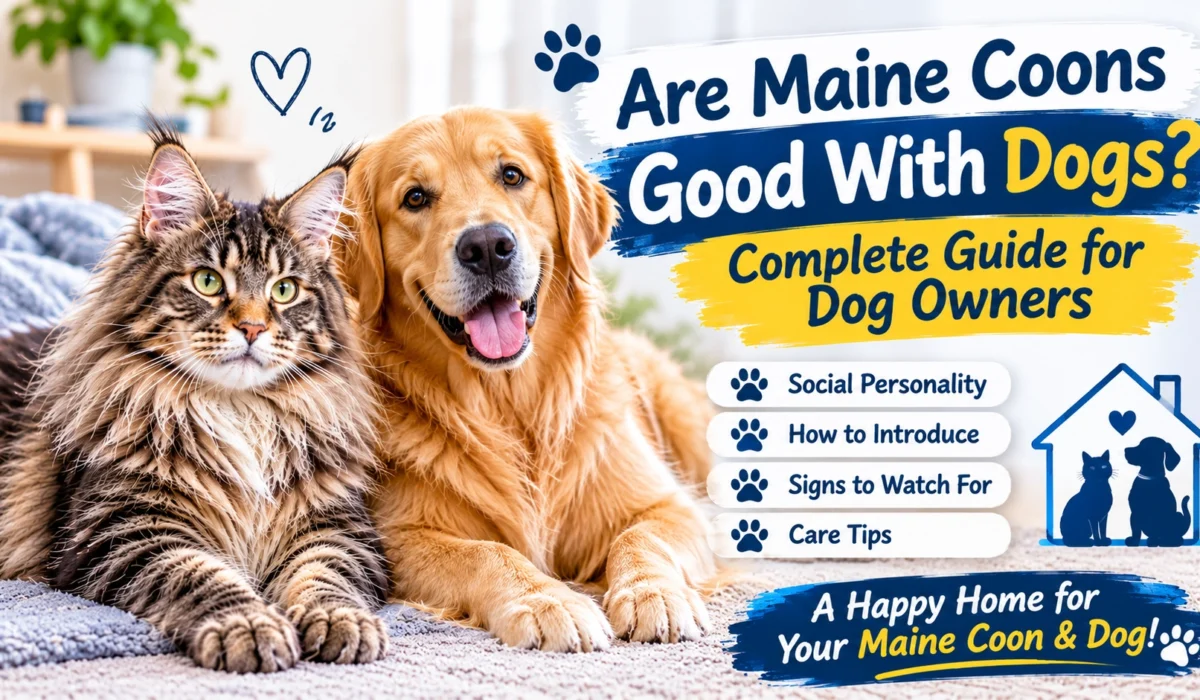
Are Maine Coons Good With Dogs? Compatibility and Tips
Are you thinking about bringing a Maine Coon into a home that already has a dog? Or perhaps you own a Maine Coon and are considering adding a four-legged companion to your family.
One of the most common questions prospective owners ask is: Are Maine Coons good with dogs?
The good news is that Maine Coons are generally known for their friendly, relaxed, and social personalities. Many enjoy living with dogs and can develop close relationships with them. They are often playful, curious, and comfortable around other household pets.
According to The International Cat Association (TICA), Maine Coons generally get along well with dogs, children, and other cats. Their gentle temperament makes them a popular choice for families with multiple pets.
However, every cat and dog has an individual personality. A successful relationship depends on temperament, early experiences, training, and how carefully you introduce them.
In this guide, we will explain why Maine Coons can make good companions for dogs, how to introduce them safely, what behaviors to watch for, and how to build a peaceful multi-pet household.
Are Maine Coons Good With Dogs?
Yes, Maine Coon cats are generally good with dogs, especially when they are properly socialized and introduced gradually. Their friendly nature, intelligence, and playful personality can help them adapt to living with canine companions.
There are several reasons why this breed can work well in dog-owning households:
- They are generally friendly and people-oriented.
- They often enjoy interactive play.
- They tend to have relaxed and adaptable personalities.
- They can become comfortable around other household pets.
- They are intelligent and often respond well to positive reinforcement.
TICA describes Maine Coons as gentle, easygoing cats that usually get along well with dogs and other cats. Many also enjoy games such as fetch and following their owners around the home.
Still, being a Maine Coon does not guarantee that a cat will immediately accept every dog.
A confident adult cat may be comfortable around a calm Golden Retriever but frightened by a highly energetic puppy. The dog’s behavior is just as important as the cat’s personality.
Why Are Maine Coons Good With Dogs?
Several characteristics can make Maine Coons suitable companions for dogs:
1. Friendly and Social Personality
Maine Coons are often described as gentle giants. Despite their impressive size, they are usually friendly and enjoy being around their human families.
Many like following people from room to room and observing household activities. This social nature can make it easier for them to become familiar with a dog that is already part of the household.
However, friendliness does not mean every Maine Coon wants constant interaction. Cats should always have the freedom to choose when they approach another animal.
2. Playful Nature
Maine Coons often remain playful well into adulthood. They enjoy chasing toys, exploring their surroundings, and participating in interactive games.
Some even enjoy playing fetch with their owners. This playful personality can help them share activities with a dog, provided both animals have compatible energy levels.
For example, a young Maine Coon may enjoy watching a dog play with a ball before eventually joining the activity. However, play should never involve chasing, cornering, or rough physical interaction.
3. Intelligent and Curious Behavior
Maine Coons are intelligent and curious cats. They often investigate new objects, sounds, and changes in their environment.
When introduced properly, a dog can become another familiar part of their household surroundings.
Some cats may follow the dog around or sit nearby while it rests. Others may prefer watching from a comfortable distance. Both responses are perfectly acceptable.
4. Adaptability to Family Life
Maine Coons are often comfortable in active family environments when their individual needs are met.
A household with children, adults, and a friendly dog can offer plenty of stimulation.
The key is maintaining separate resources and providing safe places where the cat can rest without being disturbed.
Can Maine Coons Live With Dogs of Different Breeds?
Yes. Maine Coons can live with many different dog breeds. However, the dog’s individual temperament, training, size, energy level, and prey drive matter more than its breed name alone.
Here are some examples of dog types that may adapt well to living with cats.
1. Golden Retrievers
Golden Retrievers are often friendly, social, and eager to interact with their families.
A well-trained Golden Retriever that has previous positive experiences with cats may make a good companion for a Maine Coon.
Both animals may enjoy spending time in the same room or relaxing near their owners.
2. Labrador Retrievers
Labradors are playful and energetic. A Maine Coon with a similar activity level may enjoy having a Labrador around.
However, young Labradors can become overly excited. Training and controlled introductions are important to prevent accidental rough play.
3. Poodles
Poodles are intelligent and often respond well to training. A calm, well-socialized Poodle may adapt comfortably to living with a Maine Coon.
Their ability to learn commands can also help owners reinforce appropriate behavior around the cat.
4. Cavalier King Charles Spaniels
Cavalier King Charles Spaniels are often affectionate and companion-oriented.
Their generally gentle nature may suit households with cats, although individual personality and training still matter.
5. Beagles
Beagles are friendly and curious but have a strong scent-hunting background. Some may become overly interested in a moving cat.
Owners should pay attention to chasing behavior and use supervised introductions rather than assuming that a friendly personality guarantees safe interactions.
Important: No dog breed is automatically safe with cats. A dog’s history of chasing or attacking smaller animals is especially important when deciding whether it can live safely with a Maine Coon.
How to Introduce a Maine Coon to a Dog?
Introducing a Maine Coon to a dog requires patience. Do not simply place them in the same room and expect them to become friends.
A gradual introduction allows both animals to become familiar with each other’s scent and presence without feeling threatened.
The American Humane Society recommends beginning with separation and scent exchange before progressing to supervised, leashed introductions.
Follow these steps.
Step 1: Prepare Separate Spaces
Before bringing the animals together, prepare a separate room for your Maine Coon.
Include:
- A comfortable bed.
- Food and fresh water.
- A litter box.
- Scratching opportunities.
- Toys.
- Hiding spaces.
- Elevated resting areas.
Your cat should have a place where the dog cannot enter. This helps the Maine Coon feel secure while adjusting to its new environment.
Step 2: Introduce Their Scents
Allow the animals to become familiar with each other’s scent before meeting face-to-face. You can exchange blankets or bedding between their resting areas.
You can also allow each animal to explore areas where the other has spent time while keeping them safely separated. Do not force either animal to approach the other’s belongings.
Step 3: Allow Controlled Visual Contact
Once both animals seem comfortable with the scent exchange, allow them to see each other through a secure barrier.
A baby gate or suitable barrier can help prevent direct contact. Keep the sessions short.
Watch how each animal responds. If your dog barks continuously or fixates on the cat, return to separation and continue training.
Step 4: Begin Supervised Meetings
When both animals appear comfortable with visual contact, arrange a short meeting.
Keep the dog on a leash.
Allow the Maine Coon to approach if it chooses. Never hold the cat in front of the dog or force an interaction.
Reward your dog for remaining calm and responding to commands. Give the cat access to a safe escape route.
Step 5: Increase Interaction Gradually
If both animals remain relaxed, gradually increase the time they spend together.
Look for signs such as:
- The dog responded to commands.
- The cat is exploring without hiding.
- Relaxed body posture.
- Normal eating and drinking.
- Calm behavior in the same room.
The American Humane Society advises waiting until both animals have demonstrated consistent calm behavior before considering unsupervised interactions. Some households may need several weeks or longer.
Never leave them together unsupervised until you have strong evidence that the relationship is safe.
Signs Your Maine Coon Is Comfortable Around Dogs
How do you know whether your Maine Coon likes your dog? Look for positive behaviors that show the cat feels secure.
Common signs include:
- Relaxed body posture.
- Normal eating and drinking.
- Resting in the same room as the dog.
- Approaching the dog voluntarily.
- Playing with toys while the dog is nearby.
- Grooming normally.
- Showing curiosity rather than fear.
Some Maine Coons may even sleep beside a familiar dog. However, your cat does not need to cuddle with the dog to have a successful relationship. Being comfortable in the same household is already a positive outcome.
Warning Signs That Your Cat Is Afraid of the Dog
Not every introduction goes smoothly. A Maine Coon may show fear or discomfort through changes in posture and behavior.
Watch for:
- Flattened ears.
- Hissing or growling.
- A tucked tail.
- Hiding for long periods.
- Repeated attempts to escape.
- Refusing food.
- Excessive grooming.
- Avoiding normal household activities.
A dog may also show warning signs, such as stiff body posture, intense staring, stalking, lunging, or repeated attempts to chase the cat.
Do not punish either animal for showing fear. Instead, increase separation and slow down the introduction.
If chasing, aggression, or persistent distress continues, consult a qualified veterinary behaviorist or experienced behavior professional.
How to Create a Dog-Friendly and Cat-Friendly Home?
A peaceful relationship depends on the environment as much as the personalities of the animals. Your Maine Coon needs safe spaces where it can rest without being disturbed.
Provide Elevated Resting Areas
Cat trees, shelves, and sturdy climbing structures allow Maine Coons to observe their surroundings from a comfortable height.
These spaces also provide an escape route when the dog becomes too energetic.
The AAFP and ISFM feline environmental guidelines identify elevated areas and safe places as important parts of a healthy cat environment.
Keep Food and Water Separate
Dogs may try to eat cat food or drink from the cat’s water bowl. Place your cat’s food and water somewhere the dog cannot easily reach.
Separate feeding stations can help prevent competition and reduce stress.
Protect the Litter Box
Your Maine Coon should have access to a quiet litter box area that the dog cannot enter. Some dogs investigate litter boxes or disturb cats when they are using them.
A baby gate or separate room can help protect your cat’s privacy.
Give Both Animals Individual Attention
Dogs and cats have different social needs. Make time for individual play, grooming, training, and relaxation.
Your Maine Coon should never feel that it has lost its preferred resting places or attention because another pet has joined the family.
Are Maine Coon Kittens Better With Dogs Than Adult Cats?
Maine Coon kittens may adapt more easily to living with a dog when they receive positive early experiences.
Kittens are naturally curious and often learn household routines while growing up. However, this does not mean adult Maine Coons cannot bond with dogs.
An adult cat that has previously lived with friendly dogs may adjust more easily than a kitten meeting a dog with strong chasing instincts.
The dog’s temperament also matters.
A calm adult dog may be a better companion for a kitten than an excitable puppy that does not understand how to interact gently.
Always supervise interactions between puppies and kittens. A large dog can accidentally injure a small kitten during play.
A Real-World Example: A Maine Coon and Golden Retriever Sharing a Home
Imagine a family that already owns a three-year-old Golden Retriever. The dog is friendly but becomes excited whenever it sees another animal. The family decides to bring home a Maine Coon kitten. Instead of introducing them immediately, they prepare a separate kitten room.
During the first few days, the animals become familiar with each other’s scents. Later, they begin seeing each other through a secure barrier. The dog receives treats whenever it remains calm. The kitten is allowed to approach when comfortable and can retreat whenever it wants.
Over the following weeks, the animals become more relaxed. Eventually, they can spend supervised time together in the living room. The kitten begins exploring while the dog rests nearby. This is a good example of why slow introductions and positive reinforcement matter.
It does not guarantee that every dog and Maine Coon will become friends, but it gives both animals a better opportunity to build a positive relationship.
How Bella Dolce Maine Coon Helps Families Prepare for a New Kitten?
Choosing the right kitten is an important decision, especially when you already have a dog at home.
At Bella Dolce Maine Coon, we believe prospective owners should understand the breed’s temperament, grooming requirements, social needs, and everyday care before bringing home a kitten.
Maine Coons can make wonderful family companions, but every kitten has an individual personality.
When discussing a kitten with a breeder, ask about its behavior, early experiences, and how it responds to everyday household activity.
Families can explore our Maine Coon kittens page to learn more. Our complete Maine Coon kitten care guide also explains feeding, socialization, grooming, play, and preparing your home.
For additional advice about encouraging positive behavior, read our Maine Coon kitten training guide.
Final Thoughts
So, are Maine Coons good with dogs? In many households, absolutely. Their friendly personalities, playful behavior, and generally relaxed temperament can make them excellent companions for dogs.
However, successful relationships do not happen automatically.
The most important factors are choosing compatible animals, introducing them gradually, providing separate resources, and allowing both pets to feel secure.
If you already own a dog and are considering a Maine Coon, take time to prepare your home and understand your dog’s behavior.
With patience, appropriate training, and careful supervision, a Maine Coon and a dog can develop a comfortable and rewarding relationship.
FAQ
Can Maine Coons live with dogs?
Yes. Maine Coons can live comfortably with dogs, particularly when both animals have suitable temperaments and receive gradual introductions. Many Maine Coons are friendly and adaptable, but individual personalities and dog behavior matter.
Are Maine Coons aggressive toward dogs?
Maine Coons are not generally known for being aggressive toward dogs. However, a cat may hiss, growl, or swat when frightened or threatened. Give the cat space and never force an interaction.
How long does it take for a Maine Coon to get along with a dog?
There is no fixed timeline. Some animals become comfortable within days, while others need several weeks or longer. Continue supervised introductions until both pets consistently demonstrate calm and safe behavior.
Can I leave my Maine Coon alone with my dog?
Only after you have established a consistent history of safe interactions and have assessed the dog’s behavior carefully. If your dog chases, fixates on, or threatens the cat, keep them separated when you are not supervising.
Also Read: Maine Coon Cat Health Issues